







SMT Production Lines and Machines: A Complete Guide to PCB Assembly Manufacturing
Today’s PCB assembly manufacturing is based on Surface Mount Technology (SMT) , which enables high-density, high-speed and high-reliability electronic production. An advanced SMT production line involves various precision machines and quality control systems to guarantee stable PCBA performance from component placement to automated inspection. In this guide we will go through the important processes, equipment, manufacturing considerations and best practices in SMT assembly. PCBMASTER provides reliable PCB and PCBA solutions for the global electronics industries with certified manufacturing facilities, state-of-the-art production systems and engineering expertise.
Understanding SMT Production Lines in Modern PCB Assembly Manufacturing
Surface Mount Technology (SMT) is a modern electronic assembly method where electronic components are mounted directly on the surface of printed circuit boards (PCBs) . Compared with traditional through-hole assembly, SMT offers smaller component sizes, higher assembly density, better production efficiency, and improved compatibility with current electronic design requirements.
Today, SMT production lines are widely used in automotive electronics, consumer electronics, industrial automation, telecom, medical equipment and smart devices. Electronic products are tending to be smaller and smarter, and producers are increasingly relying on automated SMT processes to reach higher accuracy and scalability in production.
A full SMT production line is not just a single machine but a complete manufacturing system with several stages of the process:
- PCB loading and preparation
- Solder paste printing
- Component placement
- Reflow soldering
- Automated optical inspection (AOI)
- Testing and quality verification
- Final assembly and packaging
Each of these stages directly affects the quality of PCB assembly, production efficiency, and the reliability of the product.
Key Machines Used in an SMT Production Line
A high-efficiency SMT production line cannot do without the cooperation of professional equipment. Each process is completed by the corresponding equipment to ensure the accuracy and reliability of the assembly.
1. Solder Paste Printer: The First Critical Step in SMT Assembly
The solder paste printer is used to print solder paste on the pads of PCB before components are placed.During this process, a stencil is placed above the PCB and solder paste is accurately deposited through the stencil openings. The solder joints reliability is directly affected by the solder paste printing quality.
Important Parameters to Consider Parameter Influence on Manufacturing
| Parameter | Manufacturing Impact |
|---|---|
| Printing accuracy | Determines solder paste alignment with PCB pads |
| Paste volume control | Prevents solder defects such as insufficient solder or bridging |
| Stencil quality | Affects fine-pitch component assembly |
For advanced PCB assemblies such as HDI boards, fine-pitch components, and high-density designs, precise solder paste printing becomes increasingly important.
2. Pick and Place Machine: High-Speed Component Mounting
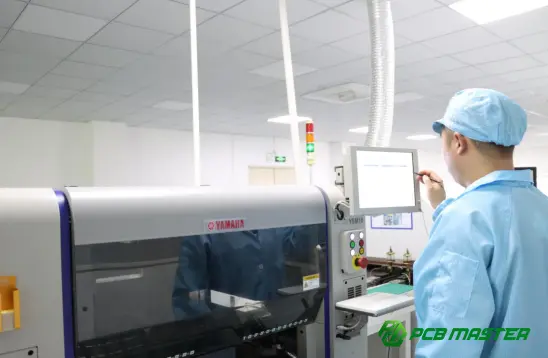
The pick and place machine is the core equipment of an SMT production line. It automatically picks electronic components from feeders and places them onto designated PCB locations.
Modern placement machines can handle:
- Resistors and capacitors
- Integrated circuits (ICs)
- Microcontrollers
- Connectors
- Fine-pitch components
- Ball grid array (BGA) packages
A high-performance pick and place system balances speed and placement accuracy.
| Feature | Standard SMT Production | Advanced SMT Manufacturing |
|---|---|---|
| Component placement | General electronic components | High-density and miniature components |
| Accuracy requirement | Standard precision | Micron-level placement control |
| Application | Basic PCB assembly | Automotive, communication, industrial electronics |
3. Reflow Oven: Creating Reliable Solder Connections
After components are placed, the PCB enters the reflow oven where controlled heating melts the solder paste and creates permanent solder joints.
A typical reflow process includes four temperature zones:
- Preheating zone
- Thermal soaking zone
- Reflow zone
- Cooling zone
Precise thermal management is essential because excessive heat may damage components, while insufficient heat may cause weak solder joints.
For industries requiring high reliability, such as automotive electronics and industrial control systems, strict reflow profile management is a key factor in ensuring long-term product performance.
4. Automated Optical Inspection (AOI): Ensuring Assembly Quality
AOI systems use cameras and image-processing technology to inspect assembled PCBs automatically.
Common defects detected by AOI include:
- Missing components
- Incorrect component placement
- Solder bridging
- Insufficient solder
- Component polarity errors
A strong quality management system combines automated inspection with professional engineering analysis.
PCBMASTER applies advanced AOI testing and multiple inspection procedures throughout production. Combined with ISO 9001 and IATF 16949 quality management systems, every PCB and PCBA product undergoes strict quality verification before shipment.
Common SMT Manufacturing Challenges and Solutions
Avoiding SMT Assembly Defects
Avoiding SMT assembly defects SMT manufacturing is highly automated, but there are several factors that can affect the quality of the assembly.
| Challenge | Possible Cause | Recommended Solution |
|---|---|---|
| Solder bridging | Excess solder paste or incorrect printing | Optimize stencil design and printing parameters |
| Component shifting | Poor placement accuracy or vibration | Calibrate placement equipment |
| Cold solder joints | Incorrect reflow temperature profile | Monitor thermal process parameters |
| Missing components | Feeder or placement errors | Implement AOI inspection |
The Role of Engineering Support in SMT Production
Successful PCB assembly is not only determined by manufacturing equipment. Engineering expertise plays an equally important role in improving manufacturability, reducing production risks, and controlling costs.
Before production, professional PCB manufacturers normally perform the following:
- Design for Manufacturing (DFM) analysis
- Check component availability
- Verify PCB files
- Optimize assembly process
- Cost reduction recommendations
PCBMASTER provides free of charge engineering file inspection services to support customers to identify potential manufacturing issues before production. This practice increases product reliability, speeds up development time and reduces unnecessary manufacturing costs.
How to Select the Right SMT Manufacturing Partner
Selecting an SMT supplier is more than just a production capacity consideration. An ideal PCB assembly partner should have full capabilities of manufacturing, engineering, quality control and delivery management.Here are the key evaluation factors:
1. Manufacturing Capability
A qualified supplier should support different PCB technologies, including:
- Multilayer PCB
- HDI PCB
- Flexible PCB (FPC)
- Rigid-Flex PCB
- High-frequency PCB
- Metal core PCB
This ensures the supplier can support projects from prototype development to mass production.
2. Quality Management System
Certifications are the proof of a manufacturer’s commitment to process control. Some of the important certifications are as follows:
| Certification | Industry Significance |
|---|---|
| ISO 9001 | Quality management system |
| IATF 16949 | Automotive electronics quality requirements |
| UL Certification | Product safety compliance |
| RoHS Certification | Environmental compliance |
PCBMASTER has acquired internationally recognized certifications, and follows strict inspection procedures to ensure reliable PCB and PCBA production.
3. Delivery Capability
The fast moving electronics markets demand that product launch schedules are directly related to production speed.
What a competent SMT manufacturer should offer:
- Fast prototyping
- Flexible production scheduling
- Stable mass production capability
- Reliable logistics support
PCBMASTER supports rapid-turn PCB prototyping and efficient production scheduling, helping customers accelerate electronic product development.
PCBMASTER’s SMT Production and PCB Assembly Solutions
PCBM ASTER is a professional PCB and PCBA manufacturer providing services to global electronics industries. We provide integrated solutions including PCB fabrication, SMT assembly, component sourcing and engineering support.
PCBMASTER has an 80,000㎡ manufacturing facility and experienced engineers to support the customer from the first design verification to the final product delivery.
Core competencies are:
- PCB & PCBA one-stop manufacturing
- SMT assembly for prototype and mass production
- Advanced PCB technologies such as HDI, FPC, rigid-flex and high-frequency PCB
- Professional engineering support and DFM optimization
- Strict quality control based on ISO 9001 and IATF 16949 systems
By combining advanced manufacturing equipment, automated inspection systems and engineering know-how, PCBMASTER helps customers to achieve reliable, scalable and cost-effective PCB assembly solutions.
Future Trends of SMT Production and PCB Assembly Manufacturing
The future of SMT manufacturing is to a higher level of automation, intelligent production management and miniaturization.Key Trends Include:
- AI-powered Inspection Systems for Accelerated Defect Detection
- Smart Factories and Industry 4.0 Manufacturing Systems
- Higher-Density PCB Assembly Technologies
- Advanced Automation for Flexible Production
- More Environmentally Sustainable Manufacturing Processes
As Electronic Products Continue to Evolve with Greater Intelligence and Connectivity, SMT Technology Will Remain a Critical Foundation for Global Electronics Manufacturing.
If you are a company looking for reliable PCB assembly solutions, you should only look at manufacturers with strong engineering capabilities, certified quality systems, advanced equipment, and proven production experience.
Tag:
#SMT #PCBAssembly #PCBAManufacturing #PCBManufacturing #ElectronicsManufacturing #PCBMASTER #IndustryInsights
About the Author

Carol Luo
PCB Design EngineerI'm Carol, a PCB Engineer at PCBMASTER with experience in PCB design and manufacturing engineering since 2018. I focus on translating engineering requirements into reliable PCB solutions, with expertise in stack-up design, material selection, and design-for-manufacturing (DFM). I share practical engineering insights from real-world PCB design and production experience.
Visit Carol Luo's Profile