








What Are PCB Countersinks and Counterbores? Differences and Applications
PCBs (Printed Circuit Boards) feature a variety of hole types, each designed for specific purposes such as component mounting, electrical connections, and mechanical fastening. These holes come in different shapes and sizes, tailored to meet the requirements of different components and assembly processes. While through-holes and vias are the most commonly discussed, there are other specialized hole types that play a crucial role in ensuring the stability and functionality of the board.
Among these specialized hole types are countersinks and counterbores—two features that are often overlooked but are essential for proper component fitting and secure assembly. Although both involve modifying the top of a hole, their shapes and purposes differ significantly. Countersinks are typically used to accommodate screws with conical heads, ensuring they sit flush with the PCB surface, while counterbores are designed for screws with flat heads, allowing them to sit below the surface.
In the following sections, we will dive deeper into what countersinks and counterbores are, explore their key differences, and discuss how to choose the right one for your specific PCB design needs.
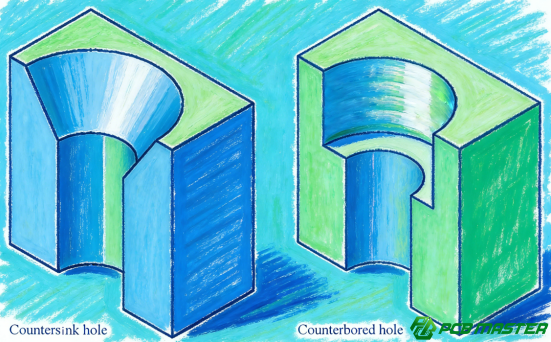
What Are PCB Countersinks and Counterbores?
Countersinks and counterbores are two specific types of holes used in PCB design, each serving a unique purpose in the assembly of components.
- Countersink: A countersink hole is a hole with a conical shape, wider at the top and narrower at the bottom. This design allows screws with a conical head (like flat-head screws) to sit flush with or slightly below the surface of the PCB. It provides a smooth, aesthetically pleasing finish and ensures the screw doesn't stick out, potentially interfering with other components.
- Counterbore: A counterbore is a hole with two different diameters. The top section of the hole is wider than the lower section, creating a flat-bottomed cavity. This design is used for screws with a flat head, allowing the screw to sit inside the hole, making it flush with or slightly below the surface of the PCB.
In PCB design, both countersinks and counterbores ensure that fasteners like screws fit securely and are properly seated, contributing to a more stable assembly.
Importance in PCB Design
Countersinks and counterbores are critical in PCB manufacturing for several reasons:
- Stability and Security: Properly designed countersinks and counterbores ensure that screws and other fasteners fit securely within the board, preventing components from becoming loose over time. This is especially important for mechanically loaded assemblies where the PCB will be subject to vibrations or movement.
- Component Attachment: These hole types make it easier to attach various components, like connectors, standoffs, or heatsinks, to the PCB. They help create the necessary clearance for the screw heads or nuts, ensuring components are tightly fixed without damaging the board or other parts.
- Quality and Precision: By allowing screws to fit properly, countersinks and counterbores improve the overall appearance and functionality of the PCB. A well-executed hole ensures the PCB remains flat, reducing the risk of warping or stress that could affect component performance. This leads to a higher-quality, more reliable product.
For example, in high-precision industries like aerospace or medical devices, where PCBs often need to withstand high stresses, countersinks and counterbores play a key role in ensuring long-term durability and safety.
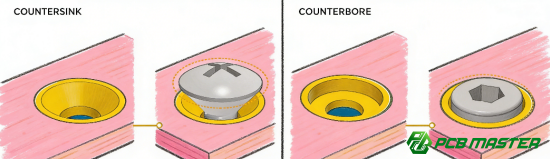
What Are the Key Differences Between PCB Countersinks and Counterbores?
The key difference between PCB countersinks and counterbores is that countersinks have a conical shape for accommodating screws with conical heads, while counterbores are cylindrical with a flat bottom, designed for flat-head screws or other components like nuts and washers.
Shape and Structure
The key geometric difference is that countersinks have a conical shape, while counterbores are cylindrical with a flat bottom.
- Countersinks: These holes have a conical shape, which means the hole tapers from a wider opening at the top to a narrower opening at the bottom. This conical design is ideal for screws with conical heads, like flat-head screws, as it allows the screw to sit flush with the surface of the PCB.
- Counterbores: Unlike countersinks, counterbores are cylindrical. They have two diameters: a wider top section that creates a flat "bore" at the surface and a narrower section that goes deeper into the PCB. This design is suitable for screws with flat heads, allowing the screw to sit inside the hole without protruding.
This difference in shape determines which types of fasteners each hole type accommodates and how they sit on the PCB.
Hole Size and Depth
Countersinks generally have a smaller depth and a conical top, while counterbores are deeper and have a cylindrical, flat-bottomed design.
- Countersinks: The depth of a countersink hole is typically shallow. The diameter of the hole at the top can vary based on the size of the screw head, but the depth of the conical taper is usually minimal. Common countersink dimensions for PCB applications are typically between 2mm to 5mm in diameter, with the depth depending on the screw head size.
- Counterbores: Counterbores, on the other hand, have a greater depth because of the flat-bottomed cavity. The top diameter is usually larger to accommodate flat-head screws, nuts, or washers. Common counterbore hole sizes range from 4mm to 10mm in diameter, with depths varying from 2mm to 5mm or more, depending on the component being used.
These size and depth variations ensure that the screws and other components fit securely without damaging the PCB.
Types of Screws and Components They Fit
Countersinks fit screws with conical heads, while counterbores are designed for screws with flat heads or other components like nuts and washers.
- Countersinks: These are primarily designed for screws that have a conical head, such as flat-head screws or countersunk screws. The shape of the hole allows these screws to sit flush with or slightly below the PCB surface, which is essential for clean and smooth finishes in assemblies.
- Counterbores: Counterbores are used for flat-head screws, nuts, or washers. The larger top diameter and flat bottom of the hole allow these components to sit neatly inside the hole, with the screw head recessed below the PCB surface. This is often necessary for mounting screws that need to be concealed or for added mechanical stability.
Choosing between countersinks and counterbores depends on the type of screw or fastener that needs to be used for the PCB assembly.
Effect on PCB Assembly
Countersinks and counterbores both impact the assembly process by providing secure fittings for fasteners, but they differ in how they affect alignment and surface clearance.
- Countersinks: Countersinks improve the alignment of the PCB by allowing screws with conical heads to sit flush or just below the PCB surface. This can reduce the risk of component interference and improve the aesthetic appearance of the finished PCB. Additionally, countersinks ensure that the screw doesn’t protrude, preventing potential damage to nearby components.
- Counterbores: Counterbores allow screws with flat heads to be recessed inside the hole, offering a more stable and secure attachment. The flat-bottom design ensures that the screw head does not exert uneven pressure on the PCB, contributing to a more secure and balanced component attachment. Counterbores are often used where a deep, stable fit is necessary, such as in industrial applications requiring extra mechanical strength.
Both types ensure stability, but their impact on surface clearance and alignment can differ based on the fastener type used.
Comparison Table: PCB Countersinks vs. Counterbores
| Feature | Countersink | Counterbore |
| Shape | Conical (tapers from top to bottom) | Cylindrical with a flat bottom |
| Depth | Shallow, minimal taper depth | Deeper with a flat bottom cavity |
| Hole Diameter | Smaller, typically 2mm to 5mm | Larger, typically 4mm to 10mm |
| Screw Type | Conical-head screws (e.g., flat-head screws) | Flat-head screws, nuts, and washers |
| Function | Allows screws to sit flush or slightly below the surface | Recesses screws and nuts for a stable fit |
| Applications | Aesthetic assembly, component alignment | Mechanical stability, deeper fastener fitting |
| Impact on PCB Assembly | Improves alignment, prevents protruding screws | Enhances screw stability, provides a clean surface fit |
What Are the Common Applications of PCB Countersinks and Counterbores?
PCB countersinks and counterbores are commonly used to securely mount components, recess screw heads for a flush surface, and accommodate fasteners like flat-head screws and nuts in industries such as aerospace, automotive, and consumer electronics.
Countersinks in PCB Assembly
Countersinks are commonly used to mount mechanical components and provide space for screws to sit flush with or slightly below the PCB surface.
- Mounting Mechanical Components: Countersinks are often used in PCB assembly for mounting components like standoffs, connectors, and other mechanical parts. By using countersunk holes, these components can be securely attached to the board without interfering with the surface, providing a clean and stable installation.
- Screw Head Clearance: Countersinks create space for screws with conical heads, allowing them to sit flush with or slightly below the surface of the PCB. This is important when the screw head needs to be recessed to avoid any interference with adjacent components or to maintain a smooth, flat surface. For example, in consumer electronics or medical devices, a countersunk screw ensures the PCB remains smooth and unobstructed.
Countersinks help achieve precision and neatness in PCB assemblies by ensuring screws and components fit perfectly without protruding, improving both the mechanical integrity and appearance of the board.
Counterbores in PCB Assembly
Counterbores are used to recess flat-head screws and secure nuts or other fasteners, ensuring a clean, flush mount for various components.
- Recessing Flat-Head Screws: Counterbores allow flat-head screws to be recessed into the PCB. This is particularly useful when you need a screw to sit perfectly below the PCB surface, ensuring a flush, clean finish. This is often needed in devices where the screw head should not be exposed, such as in precision machinery or devices with delicate components.
- Securing Nuts and Other Fasteners: In some cases, counterbores are used to secure nuts, bolts, or washers in PCB assemblies. The wider top diameter and flat-bottom cavity accommodate these fasteners, ensuring they stay securely in place. This is common in industries where strong mechanical connections are necessary, such as in automotive electronics or heavy machinery.
Using counterbores helps ensure that screws and other fasteners are securely seated, improving the overall stability and mechanical performance of the PCB assembly.
Industry-Specific Uses
Countersinks and counterbores are critical in various industries, including aerospace, automotive, and consumer electronics, for ensuring secure component attachment and durability.
- Aerospace: In the aerospace industry, PCBs need to be both durable and precise, as components must withstand high stresses and vibrations. Countersinks and counterbores are essential for securely mounting critical components like connectors and sensors, ensuring the PCB remains stable under demanding conditions.
- Automotive: In automotive applications, PCBs control key systems like engine management and safety features. Counterbores are commonly used to ensure flat-head screws are recessed securely, and countersinks help with component alignment in tight spaces. This ensures that all parts stay securely attached, even in the presence of high vibrations and temperature fluctuations.
- Consumer Electronics: In consumer electronics like smartphones and computers, both countersinks and counterbores are used to ensure components like screens, batteries, and connectors fit perfectly. These holes ensure smooth surface finishes and make it easier to assemble complex devices without causing interference between parts.
By using countersinks and counterbores, these industries can improve the mechanical stability and reliability of their products, reducing the risk of failure and enhancing overall performance.
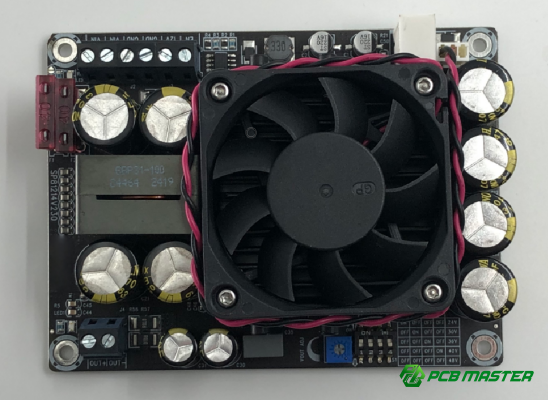
How Do You Choose Between a PCB Countersink and Counterbore?
The choice between a PCB countersink and counterbore depends on the type of screw or fastener used, the desired surface flushness, and the mechanical stability requirements for the assembly.
Factors to Consider When Choosing
The decision between a countersink and a counterbore depends on the type of screw or fastener used, the desired surface flushness, and the mechanical stability requirements for the assembly.
- Type of Screw or Fastener: The most important factor in choosing between countersinks and counterbores is the type of fastener being used. Countersinks are designed for screws with conical heads, such as flat-head screws, while counterbores are best for screws with flat heads or other components like nuts and washers. If the fastener has a conical head, countersinks are the appropriate choice, but for flat-head screws, counterbores are needed to ensure a secure, recessed fit.
- Desired Surface Flushness or Fitting: If you need the screw head to sit flush with or slightly below the PCB surface, countersinks are ideal, as they provide a smooth, tapered hole that matches the screw's shape. In cases where a flat-head screw or nut needs to be recessed completely within the hole, counterbores are the better choice because of their flat-bottom design.
- Mechanical Stability Requirements: For applications that require a secure and stable mechanical connection, counterbores are often preferred because they provide a deeper, more stable cavity for flat-head screws, nuts, or washers. This helps distribute the mechanical load more evenly, improving the overall strength and reliability of the assembly.
Common Scenarios for Choosing One Over the Other
Countersinks are often used in aesthetic or space-sensitive applications, while counterbores are chosen when mechanical strength and secure attachment are the priorities.
- Countersinks in Aesthetic and Space-Sensitive Applications: Countersinks are commonly used when the appearance and smoothness of the PCB surface are important. For example, in consumer electronics like smartphones or laptops, countersinks help ensure that screws do not protrude from the surface, giving the device a clean, sleek finish. They are also used in designs where space is limited and a flush screw head is required to avoid interference with adjacent components.
- Counterbores for Mechanical Strength: Counterbores are often chosen for applications where the strength of the screw attachment is critical. In industrial devices, automotive electronics, or aerospace applications, counterbores are used to ensure that screws or nuts are recessed securely into the board, offering a stronger, more stable mechanical connection. This is especially important in high-stress environments where the assembly needs to withstand vibrations or heavy forces.
For example, in automotive electronics, where vibration and movement are significant, counterbores help provide a stable and secure attachment for flat-head screws, preventing loosening over time. Conversely, in consumer electronics, where appearance and tight spaces are more important, countersinks are used to achieve a smooth, flush surface.
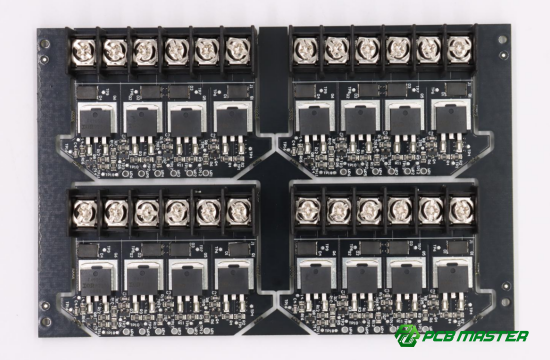
Conclusion
The main difference between PCB countersinks and counterbores lies in their shape and the types of screws or fasteners they accommodate. Countersinks feature a conical shape and are used for screws with conical heads, ensuring a flush surface. On the other hand, counterbores have a cylindrical shape with a flat bottom, perfect for flat-head screws or nuts that need to be recessed. The choice between the two depends on factors such as the type of screw, the desired flushness of the surface, and the mechanical stability required for the assembly.
Understanding these two hole types and their applications is essential for achieving a well-constructed PCB that meets both functional and aesthetic requirements. Whether you’re building consumer electronics or industrial devices, choosing the right hole type can enhance the efficiency and overall quality of the manufacturing and assembly process.
For businesses looking for precision and reliability in their PCB and PCBA designs, partnering with an experienced supplier like PCBMASTER can ensure that countersinks and counterbores are expertly tailored to your specific needs, optimizing both performance and durability in your final product.
FAQs
1. What Is the Difference Between Countersink and Counterbore in PCB Design?
Countersink and counterbore are two types of holes used in PCB design, each serving different purposes:
- Countersink: This type of hole has a conical shape, tapering wider at the top and narrower at the bottom. It is designed to accommodate screws with conical heads, like flat-head screws, ensuring the screw sits flush with or slightly below the PCB surface.
- Counterbore: A counterbore hole is cylindrical with a flat bottom and a wider diameter at the top. It is used for flat-head screws, nuts, or washers, allowing the fasteners to sit below the surface of the PCB, providing a more secure and stable fit.
In summary, countersinks are used for conical screws, while counterbores are used for flat-head screws or other components that need to be recessed.
2. Can Countersinks and Counterbores Be Used Interchangeably?
Countersinks and counterbores cannot always be used interchangeably due to their distinct shapes and functions:
- Countersinks are designed for screws with conical heads. Using a counterbore for such screws would lead to an unstable fit, as the screw's head wouldn't be flush with the surface.
- Counterbores are designed for flat-head screws or other components like nuts. Using a countersink for flat-head screws would create an improperly recessed fit, making the attachment less secure.
However, in certain cases, a counterbore may be used instead of a countersink for aesthetic or functional reasons, as long as the screw fits securely. The limitation is that the screw head will not be fully flush with the surface if a counterbore is used where a countersink is intended.
3. What Tools Are Used to Create Countersinks and Counterbores in PCB Manufacturing?
The tools used to create countersinks and counterbores in PCB manufacturing typically include:
- CNC Machines:Computer Numerical Control (CNC) machines are the most common tools for drilling precise countersinks and counterbores. CNC machines can be programmed to create exact shapes and depths for both hole types.
- Drill Press: A standard drill press can be used for manual drilling of countersinks and counterbores, although it requires more skill and precision to achieve the correct dimensions.
- Specialized Drilling Tools: Tools such as countersink drills or counterbore bits are designed specifically for these types of holes. They have adjustable cutting edges to ensure the right taper (for countersinks) or flat bottom (for counterbores).
The proper tool selection and machine adjustments ensure that the countersinks and counterbores are accurately created, which is essential for proper screw fit and mechanical stability.
4. Do PCB Countersinks or Counterbores Affect the Durability of the Board?
Yes, PCB countersinks and counterbores can influence the durability and mechanical performance of the PCB, especially in high-stress environments:
- Countersinks: When done correctly, countersinks ensure that screws sit flush with or slightly below the PCB surface, which can prevent screw heads from interfering with other components. However, improper countersinking may weaken the PCB’s structure, especially if the hole depth is too deep or the screw is not securely seated.
- Counterbores: These provide a more stable and secure fit for screws and nuts, especially in high-stress applications. Counterbores are particularly beneficial in situations where high mechanical loads or vibrations are present, such as in automotive or aerospace applications, as they help distribute stress evenly.
Both countersinks and counterbores, when accurately designed, improve the overall strength and reliability of the PCB by ensuring the fasteners are securely attached without causing damage to the board.
5. What Are the Best Practices for Designing Countersinks and Counterbores in PCB Layout?
When designing countersinks and counterbores in PCB layout, it's crucial to follow these best practices:
- Use Precise Dimensions: Ensure the hole diameter and depth are accurately measured based on the type of screw or fastener to be used. For countersinks, ensure the angle and diameter of the conical taper match the screw's specifications. For counterbores, ensure the diameter of the flat section accommodates the flat-head screw or nut.
- Avoid Over-Drilling: Be cautious not to drill too deeply, as this can compromise the structural integrity of the PCB. The hole should be deep enough to accommodate the fastener but not so deep that it weakens the board.
- Account for Tolerances: Allow for slight manufacturing tolerances when designing holes, especially for countersinks and counterbores, as minor discrepancies can affect the fit of the screw or component.
- Simulation Tools: Use PCB design software to simulate the layout and ensure that countersinks and counterbores are properly aligned with the components they will be used with. This helps prevent interference with other parts of the PCB.
By following these best practices, you can ensure that countersinks and counterbores are precisely designed, resulting in a high-quality, functional, and durable PCB.
About the Author

Carol Luo
PCB Design EngineerI'm Carol, a PCB Engineer at PCBMASTER with experience in PCB design and manufacturing engineering since 2018. I focus on translating engineering requirements into reliable PCB solutions, with expertise in stack-up design, material selection, and design-for-manufacturing (DFM). I share practical engineering insights from real-world PCB design and production experience.
Visit Carol Luo's Profile