








Standard Resistor Values Explained: E-Series, Charts & Selection Guide
Every electronic circuit needs resistors but not all resistance values are available in the market. But, the manufacturers make resistors in a limited number of preferred values, so that components can be selected more uniformly, economically and compatibly among designs. That’s why engineers and hobbyists sometimes have to choose the next closest resistor they can find, not the exact calculated value.
Knowing the organization of these common resistor values can make designing circuits easier and help you pick parts better. This manual will walk you through the E-Series system, explain how to read standard resistor value charts, and show you how to confidently choose the right resistor for your application. If you design PCBs, repair electronic equipment, or are learning electronics, you will get a practical understanding of the standard values used throughout the industry.
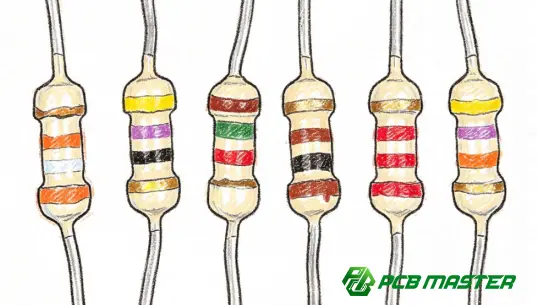
What Are Standard Resistor Values?
Standard resistor values are predefined resistance values that are manufactured to make it easier to carry out electronic design, production and component selection. Instead of making every resistance value , resistor manufacturers use standard value systems . The systems have been designed to provide the most commonly required choices for the different levels of tolerance.
These common resistor values are often used in PCB design and electronic circuits and in component sourcing, because they allow engineers to easily select already available parts, without having to order custom made resistors.
Definition of standard resistor values
The standard resistor values are the officially defined resistance values and are easily available from resistor manufacturers.
The resistance of a resistor is measured in ohms (Ω) but not all values are made as standard components, e.g. 237Ω or 4.83kΩ. Instead, resistors are produced in preferred values covering the practical range of values required for most electronic applications.
For example, standard resistor values are:
- 10Ω
- 100Ω
- 1kΩ
- 4.7kΩ
- 10kΩ
- 100kΩ
They are part of the E-Series resistor value system. The E-Series categorizes resistor values into standard groups based on the tolerance requirements.
Also, the standard resistor values make it possible for PCB designers and engineers to select the commonly available, cost-effective and mass production-friendly components.
Why standard resistor values exist
Resistors have standard values. It is not economical to make all possible values of resistance, and most circuits do not require very accurate values of resistance.
If there were no standard resistor values , engineers would have to pick from thousands of different possible values of resistance . This would complicate the designs and increase the manufacturing costs.
The benefits of the preferred value system are:
- Simpler component selection: Engineers can quickly find suitable resistor values during circuit design.
- Lower manufacturing costs: Standard values are produced in large quantities, making them more affordable.
- Better inventory management: Electronics manufacturers can stock fewer resistor types while covering most design needs.
- Improved compatibility: Standard values ensure components from different suppliers can be easily replaced.
Depending on the circuit requirements, the engineer may choose to use the standard 10kΩ resistor if the circuit calculation requires a 9.8kΩ resistor.
How the IEC 60063 standard defines preferred values
Preferred values for resistors are provided in IEC 60063. It assigns a value to each decade of resistance which is equally spaced on a logarithmic scale.
IEC 60063 Preferred number series for resistors and other electronic components This international standard . These series are known as E-Series and they are:
- E3
- E6
- E12
- E24
- E48
- E96
- E192
The number after letter E is the number of standard values in decade.
For example:
- E12 series: Contains 12 values per decade and is commonly used for ±10% tolerance resistors.
- E24 series: Contains 24 values per decade and is commonly used for ±5% tolerance resistors.
- E96 series: Contains 96 values per decade and is commonly used for precision ±1% resistors.
For example, a decade is a factor of ten range of resistance:
- 10Ω to 100Ω
- 100Ω to 1kΩ
- 1kΩ to 10kΩ
The same favorite values reappear decade after decade. For example the E24 value 4.7 is written as:
- 4.7Ω
- 47Ω
- 470Ω
- 4.7kΩ
- 47kΩ
The logarithmic nature allows the wide range of resistance to be efficiently covered with standard resistor values.
How resistor tolerance relates to standard values
The tolerance of a resistor indicates the number of standard values in a set of resistance . This directly affects the choice of E-Series .
Tolerance is the permissible deviation of the actual resistance from the marked value. A 10kΩ resistor with a ±5% tolerance could be as low as 9.5kΩ or as high as 10.5kΩ.
Usually:
- Lower precision requirements use fewer standard values.
- Higher precision requirements require more available resistor values.
Relationships common are:
| E-Series | Typical Tolerance | Example Values per Decade |
|---|---|---|
| E6 | ±20% | 6 values |
| E12 | ±10% | 12 values |
| E24 | ±5% | 24 values |
| E96 | ±1% | 96 values |
| E192 | ±0.5%, ±0.25% | 192 values |
A simple LED current limiting circuit , for example , might use an E12 or E24 resistor . Small changes in resistance often don 't make much of a difference . But an E96 or E192 resistor might be needed for a precise measurement circuit to maintain the accurate performance.
The relation between standard resistor values and tolerance allows the engineer to balance accuracy, availability and cost.

What Are the Different E-Series Standard Resistor Values?
The different E-Series standard resistor values are pre-calculated sets of preferred resistance values used by manufacturers to deliver practical resistance options of different tolerance. The main E-Series are E3, E6, E12, E24, E48, E96 and E192. Each series contains a different number of resistance values per decade. This gives engineers a choice between standard resistors at a lower cost, or higher precision components.
The E-Series system is one of the preferred number systems of the IEC 60063 and it is widely used for resistor selection in PCB design, electronic circuits and component manufacturing.
Overview of the E3, E6, E12, E24, E48, E96, and E192 series
The main difference between resistor values of the E-Series is the amount of resistor steps each decade and the precision they can support.
A higher E number means more resistor values available and smaller differences between neighbouring values.
| E-Series | Values per Decade | Typical Tolerance | Common Usage |
|---|---|---|---|
| E3 | 3 | ±40% | Special-purpose applications |
| E6 | 6 | ±20% | General electronics with low precision requirements |
| E12 | 12 | ±10% | Consumer electronics and basic circuits |
| E24 | 24 | ±5% | Most common general-purpose resistors |
| E48 | 48 | ±2% | Higher accuracy circuits |
| E96 | 96 | ±1% | Precision analog and measurement circuits |
| E192 | 192 | ±0.5%, ±0.25%, ±0.1% | High-precision applications |
For example an E12 series of values can be 10kΩ, 12kΩ, 15kΩ, 18kΩ. An E96 series gives closer values such as 10.0kΩ, 10.2kΩ, 10.5kΩ, 10.7kΩ, etc.
The choice of E-Series depends on the required accuracy, sensitivity of the circuit and cost of manufacturing.
Number of values per decade
Values per decade gives the number of standard resistor values available within a ten times resistance range.
Each decade is the range between a resistance value and the same value multiplied by ten. Examples:
- 10Ω to 100Ω
- 100Ω to 1kΩ
- 1kΩ to 10kΩ
The E-Series breaks each decade into equal logarithmic steps.
For instance:
- E12 has 12 values between 10Ω and 100Ω.
- E24 has 24 values between 100Ω and 1kΩ.
- E96 has 96 values between 1kΩ and 10kΩ.
The more the number of values per decade, the closer the engineer can choose a resistance to the calculated design value.
For example, if the circuit is calculated to be about 3.3kΩ:
- An E12 series may only offer 3.3kΩ.
- An E96 series may provide more precise nearby options depending on the required tolerance.
Associated tolerance
Each E-Series resistor value has a defined tolerance range, but some manufacturers may provide variations.
Tolerance is the allowable deviation of the actual resistance from the nominal value.
Typical relationships are:
- E6: Usually ±20% tolerance
- E12: Usually ±10% tolerance
- E24: Usually ±5% tolerance
- E48: Usually ±2% tolerance
- E96: Usually ±1% tolerance
- E192: Usually ±0.5% or better tolerance
So a 1kΩ resistor of ±5 % tolerance might actually be anywhere between 950Ω and 1050Ω. The change of a 1k resistor with +/-1% tolerance will be far less.
In general, higher precision resistors are more expensive because they require tighter manufacturing controls and more standard values available.
Typical applications
Depending on the required accuracy and cost, different applications require different values of E-Series resistors.
Typical applications are:
E12 and E24 resistor values:
- LED circuits
- Pull-up and pull-down resistors
- Basic control circuits
- Consumer electronics
E48 and E96 resistor values:
- Analog amplifiers
- Sensor circuits
- Power supply feedback circuits
- Industrial control systems
E192 resistor values:
- Precision measurement equipment
- Calibration circuits
- High-end instrumentation
For example, a simple PCB with indicator LEDs may use E24 resistors as the difference between one resistor and the next will not matter much in the performance of the circuit. But at some voltages voltage reference circuit may need E96 or E192 values for accuracy of output voltage.
How E-Series values are organized
Resistor values are distributed evenly across each decade on a logarithmic scale (the E-Series).
The E-Series is not a simple linear series where the values increase by an equal amount, but rather by a percentage. This approach guarantees a constant ratio of the values of the adjacent resistors.
For example, the difference between:
- 10Ω and 12Ω
- 1kΩ and 1.2kΩ
is about the same percentage-wise.
This organization enables a small number of resistor values to cover a very large resistance range.
The E-Series structure is used to maintain consistency of component selection across different types of resistors, such as through-hole resistors and surface-mount devices (SMD) resistors for manufacturers and engineers.
How resistor values repeat across decades
Then the base values are multiplied by powers of 10 to repeat standard values for different decades.
Once you have defined an E-Series value, you can use it in a variety of resistance ranges.
For example, a base value of 4.7 lies in the E24 series and it looks like this:
- 4.7Ω
- 47Ω
- 470Ω
- 4.7kΩ
- 47kΩ
- 470kΩ
Similarly an E96 value like 10.0 may look like:
- 10Ω
- 100Ω
- 1kΩ
- 10kΩ
- 100kΩ
This pattern repeats so it is easier to select a resistor, since the engineer only needs to know one decade of values.+
When designing a PCB, engineers can quickly find the closest available component for the resistance range they need by using a standard resistor values chart.

What Does the Standard Resistor Values Chart Show?
The standard resistance values chart lists the preferred resistance values available in each E-Series, enabling engineers to quickly choose a suitable resistor for a circuit design.
The chart lists resistor values by series, e.g. E6, E12, E24, E48, E96, and E192. The number of resistance values per decade in each series is different, and the resistance ranges repeat.
In PCB design, circuit calculation and component selection, a resistor value chart is often used since it shows what resistance values are commercially available, not the theoretical values that might not be manufactured.
If a circuit calculation calls for a 4.6kΩ resistor, a standard resistor values chart would allow engineers to find the closest available value, such as 4.7kΩ.
How to read a standard resistor values chart
Find the desired E-Series, select the base resistance value and multiply it by the desired decade .
The standard resistor value charts are usually organized with 3 important elements:
1. E-Series selection
- Choose the series based on required tolerance.
- Example: E24 for ±5% resistors or E96 for ±1% resistors.
2. Base values
- These are the numbers listed in one decade.
- Example: E12 includes values such as 1.0, 1.2, 1.5, 1.8, and 2.2.
3. Resistance decade
- Multiply the base value by 10, 100, 1,000, or other factors.
-
Example:
• 4.7 × 1 = 4.7Ω
• 4.7 × 1,000 = 4.7kΩ
A practical choice process:
Step 1: Determine the required resistance, from the circuit design.
Step 2: Select the resistor tolerance requirement.
Step 3: Locate the next available value in the correct E-Series chart.
Step 4: Look at the resistor power rating and package type.
This will make sure that the resistor is available and suitable for the application.
E6 standard resistor values chart
The E6 standard resistor values chart features 6 preferred values per decade and is mainly used for low precision resistors having a tolerance of ± 20%.
The E6 series has a limited number of resistance values , so it is easy and cheap to use for simple electronics .
| E6 Value | Example Resistance Values |
|---|---|
| 1.0 | 10Ω, 100Ω, 1kΩ |
| 1.5 | 15Ω, 150Ω, 1.5kΩ |
| 2.2 | 22Ω, 220Ω, 2.2kΩ |
| 3.3 | 33Ω, 330Ω, 3.3kΩ |
| 4.7 | 47Ω, 470Ω, 4.7kΩ |
| 6.8 | 68Ω, 680Ω, 6.8kΩ |
E6 resistor values are typically used when the exact resistance is not critical, for example:
- Simple bias circuits
- Basic power circuits
- General-purpose electronics
For example, a circuit that needs about 680Ω can use an E6 680Ω resistor as the tolerance range is acceptable for the application.
E12 standard resistor values chart
The E12 standard resistor values chart has 12 values per decade and is commonly used for general purpose resistors with ±10% tolerance.
The E12 series is more choice than E6, but still low cost and widely available.
| E12 Value | Example Resistance Values |
|---|---|
| 1.0 | 100Ω, 1kΩ, 10kΩ |
| 1.2 | 120Ω, 1.2kΩ, 12kΩ |
| 1.5 | 150Ω, 1.5kΩ, 15kΩ |
| 1.8 | 180Ω, 1.8kΩ, 18kΩ |
| 2.2 | 220Ω, 2.2kΩ, 22kΩ |
| 2.7 | 270Ω, 2.7kΩ, 27kΩ |
| 3.3 | 330Ω, 3.3kΩ, 33kΩ |
| 3.9 | 390Ω, 3.9kΩ, 39kΩ |
| 4.7 | 470Ω, 4.7kΩ, 47kΩ |
| 5.6 | 560Ω, 5.6kΩ, 56kΩ |
| 6.8 | 680Ω, 6.8kΩ, 68kΩ |
| 8.2 | 820Ω, 8.2kΩ, 82kΩ |
E12 resistor values are often found in:
- Consumer electronics
- LED circuits
- Pull-up and pull-down resistor networks
- Basic PCB assemblies
E12 is sufficient for many typical PCB designs and keeps component costs low.
E24 standard resistor values chart
One of the most commonly used resistor value series for ±5% tolerance resistors is the E24 standard resistor values chart which contains 24 values per decade.
The E24 series has smaller resistance steps than the E12, and can therefore be used in a wider range of electronic designs.
Typical values for the E24 series of resistors are:
| E24 Values (per decade) |
|---|
| 1.0, 1.1, 1.2, 1.3, 1.5, 1.6 |
| 1.8, 2.0, 2.2, 2.4, 2.7, 3.0 |
| 3.3, 3.6, 3.9, 4.3, 4.7, 5.1 |
| 5.6, 6.2, 6.8, 7.5, 8.2, 9.1 |
Samples from different decades:
- 4.7Ω
- 47Ω
- 470Ω
- 4.7kΩ
- 47kΩ
E24 resistors are often found in:
- Analog circuits
- Signal conditioning circuits
- Power supply designs
- General PCB manufacturing
E24 is often the default choice for many electronic projects as it gives a good balance of accuracy, availability and cost.
Overview of the E48, E96, and E192 charts
Resistor value charts E48, E96 and E192 provide more precise resistance choices for circuits with more control of electrical performance.
These higher E-Series charts have values that are more dense per decade:
| Series | Values per Decade | Typical Tolerance |
|---|---|---|
| E48 | 48 | ±2% |
| E96 | 96 | ±1% |
| E192 | 192 | ±0.5% or better |
Application examples:
E48 resistor values
- Precision industrial circuits
- Improved analog designs
E96 resistor values
- Sensor circuits
- Measurement equipment
- Voltage divider networks
E192 resistor values
- Calibration systems
- High-accuracy instrumentation
- Specialized electronic equipment
These charts feature smaller steps between resistance values than E12 or E24. This allows engineers to choose a resistor closer to the calculated value when circuit accuracy is a must .
For example, a voltage divider circuit that requires a precise output voltage may use an E96 resistor value instead of a general-purpose E24 value to reduce calculation error.
How Do You Choose the Right Standard Resistor Value?
For choosing the right standard resistor value you should: Find the resistance you want Pick the correct tolerance Choose the correct E-Series Make sure the resistor is rated to safely operate in the circuit
In electronic design, the resistance value calculated may not be a commercial resistor value available in practice. Engineers will typically choose the nearest standard resistor value that will meet the requirements of the circuit, considering accuracy, cost and availability .
A well thought out resistor selection process can help ensure reliable PCB performance, stable operation of the circuit, and easier sourcing of the components.
Calculate the required resistance
The first step is to calculate the resistance required to perform the function of the circuit and select a standard resistor value.
The value of the resistance required depends on the function of the resistor, such as current limiting, voltage division, gain or signal level.
Typical examples of calculations are:
Current-limiting resistor:
- A resistor used with an LED can be calculated using:
- Resistance = (Supply voltage − LED voltage) ÷ LED current
Voltage divider resistor:
- Resistor values are selected based on the desired output voltage ratio.
For example, for an LED circuit with a 5V supply, LED voltage drop of 2V and current of 10mA:
- Required resistance = (5V − 2V) ÷ 0.01A
- Required resistance = 300Ω
In some resistor series 300Ω is not the preferred value . The designer may select a nearest standard value like 330Ω .
Select the appropriate tolerance
The right resistor tolerance depends on how sensitive the circuit is to variations in resistance.
Tolerance is the allowable deviation of the marked value of resistance and the measured value.
Such as this:
- A 1kΩ resistor with ±5% tolerance may measure between 950Ω and 1050Ω.
- A 1kΩ resistor with ±1% tolerance may measure between 990Ω and 1010Ω.
General criteria for selection:
- ±10% or ±5% tolerance: Suitable for most general electronic circuits.
- ±1% tolerance: Recommended for precision circuits, sensors, and measurement applications.
- ±0.5% or tighter tolerance: Used for high-accuracy designs.
The higher the tolerance requirement the higher the E-Series value you will need to use. Typically E96 or E192, as these series give you more standard resistor values to choose from.
Choose the correct E-Series
The required tolerance, precision and application requirements determine the appropriate E-Series.
The E-Series have different quantities of resistor values for each decade:
| E-Series | Typical Tolerance | Suitable Applications |
|---|---|---|
| E12 | ±10% | Basic circuits and cost-sensitive designs |
| E24 | ±5% | General PCB designs and consumer electronics |
| E48 | ±2% | More accurate analog circuits |
| E96 | ±1% | Precision circuits and measurement systems |
| E192 | ±0.5% or better | High-precision applications |
Example:
- For a simple transistor switching circuit you might only need an E12 or E24 resistor
- You might want an E96 resistor in a sensor signal conditioning circuit to keep readings accurate.
Selecting the right E-Series will prevent unnecessary expense and keep the circuit operating as it was intended.
Find the nearest available standard value
Once you've done the math and know what resistance you need, obtain the closest one you can find from the appropriate chart of standard resistor values.
Resistors come in certain values only. You might not find the exact resistance you have calculated.
The selection process is as follows:
- Calculate the ideal resistance value.
- Select the required tolerance.
- Check the matching E-Series chart.
- Choose the closest standard resistor value.
- Verify circuit performance.
For example:
Circuit calculation requires a resistance of 985Ω.
Choices:
- E24: 1kΩ
- E96: 976Ω or 1kΩ
For a closer value in your circuit, 976Ω from the E96 series would be a better choice. For a simple application a 1kOhm resistor of the E24 series may be enough.
Verify power rating and operating conditions
A standard value resistor should also satisfy the circuit's power, voltage and environmental requirements.
Choosing a resistor isn't just a matter of the resistance value. The resistor must withstand the electrical stress during operation.
Key factors are:
Power-rating
The watt rating of a resistor tells you how much heat it can safely dissipate.
Typical ratings are:
- 0.125W
- 0.25W
- 0.5W
- 1W
- Higher power ratings for industrial applications
For example , you may need a 0.5W or 1W resistor instead of the typical 0.25W resistor if the current is higher .
Operating Temperature
True resistance may vary with changes in temperature. Resistors with low temperature coefficients are frequently required in precision circuits to maintain accuracy.
Package dimensions
In PCB assembly, a resistor package must be compatible with the board design:
- Through-hole resistors for traditional assembly
- SMD resistors for compact PCB designs
These factors are compared to the chosen standard resistor value for reliable operation in the final product.
Example of selecting a standard resistor value
Engineers choose a standard resistor value when no calculated value is available. An example is given.
What the project requires:
PCB designer need a resistor for LED indicator circuit.
Given:
- Supply voltage: 5V
- LED forward voltage: 2V
- Required LED current: 15mA
Step 1: Calculate resistance
Resistance = (5V − 2V) ÷ 0.015A
Resistance = 200Ω
Step 2: Select Tolerance
The LED indicator is not of high precision. A ±5% tolerance resistor is OK.
Step 3: Choose E-Series
The E24 series is recommended for ±5% resistors.
Step 4: Select a standard value
Closest common E24 value is:
220 Ω
Step 5: Verifying the power rating
Power:
P = I² × R
P = (0.015A)² × 220Ω
P ≈ 0.05W
Any standard.125 W or.25 W resistor will do.
Final selection: 220Ω, ±5%, E24 series resistor
In this case, selecting a standard resistor value is more than just finding a resistance that matches. The final decision must take tolerance, availability, power rating and circuit requirements into account simultaneously.

When Can You Substitute a Standard Resistor Value?
A standard resistor value can be used if the replacement resistor has an acceptable difference in resistance, tolerance, power rating and electrical performance for the circuit.
In real life PCB design and electronic repair the exact calculated value of the resistor is not always at hand. engineers will often choose the nearest value from an E-Series chart if changing the value would not adversely affect the operation of the circuit.
But substitution is not always guaranteed. Some circuits , especially those requiring very precise voltage , current , timing or measurement accuracy , may require the exact value resistor or a higher precision component .
When substitution is acceptable
If small changes in resistance are not going to significantly affect the performance of the circuit then a standard resistor value can be used.
In many electronic circuits, a tolerance range is built in, so expect small differences in resistance.
In general, the usual cases where replacement of resistors is generally acceptable are:
- LED current-limiting circuits: A small resistance change usually only causes a minor brightness difference.
- Pull-up and pull-down resistors: Digital circuits often tolerate nearby resistor values.
- General bias circuits: Small voltage changes may not affect transistor operation significantly.
- Non-critical analog circuits: Applications without strict accuracy requirements can often use nearby values.
For example , a circuit calculation might call for a 470Ω resistor but only a 510Ω resistor might be available . If the change in current is within an acceptable range , the substitution might work .
The important thing is that the circuit can take the difference in resistance . Not that the replacement value is exactly as calculated .
How to choose the nearest available value
Compare the computed resistance with the values in the appropriate E-Series chart to determine the nearest standard resistor value.
A pragmatic choice process would be:
Step 1: Find the optimal resistance
"Get the resistance you need from the circuit design.
For example:
A voltage divider calculation requires a 9.5kΩ resistor.
Step 2: Select the needed tolerance
Choose the tolerance according to the circuit accuracy requirements.
- ±5% for general-purpose circuits
- ±1% for precision circuits
Step 3: Review chart of standard resistor values
Find the nearest value available in the selected E-Series.
For example,
Required value: 9.5kΩ
Available options:
- E24: 9.1kΩ or 10kΩ
- E96: 9.53kΩ
10kΩ may be okay for a simple circuit. A 9.53k ohm resistor from the E96 series would be a better choice for a precision voltage divider.
Step 4: Observe circuit effect
Always check the change of resistance if it affects current, voltage, power or signal accuracy.
Effects on circuit performance
Substituting a resistor with a different standard value can affect current, voltage, power consumption and accuracy of the circuit.
The effect depends on what the resistor is up to.
Changes in progress
In the present limiting circuits, the greater the resistance, the less the current, and the less the resistance, the greater the current.
Here is an example:
Replacing a 220Ω LED resistor with a 330Ω resistor will lower the LED current and make the LED a little dimmer.
Voltage fluctuations
The output voltage changes in direct proportion when you change the resistor in a voltage divider circuit .
For example:
Increasing the resistor to 12kΩ from 10kΩ will change the voltage at the divider output and may affect sensor readings or reference levels.
Timing changes
In RC circuits the charge and discharge time is determined by the resistor values.
Changing the value of another resistor might change the delay timing or filter frequency.
Accuracy differs
In high precision circuits, such as measurement systems, the use of a resistor value close to the designed value, rather than the designed value may cause noticeable error.
Thus the engineer should think about the resistor's part in the circuit before substituting it.
When substitution should be avoided
Do not substitute if a small change in resistance can cause improper operation , safety problems or inaccurate results .
Applications such as require careful resistor selection:
Circuit instrumentation
High resistance accuracy is often needed in sensor circuits, calibration systems, and reference circuits.
And small differences in resistance can cause measurement errors.
Regulator circuits
In power supplies, the feedback loops rely on precise resistor ratios to regulate the output voltage.
If the value is not correct, then the output voltage may be incorrect or unstable.
Timing and Frequency Circuits
The resistor values are critical to the operation of oscillators, filters and RC timing circuits.
Resistance changes can cause frequency or timing accuracy issues.
High power applications
Resistance and power rating must be matched for power resistors.
If you change the resistor value to allow more current to flow, it may overheat.
Safety related circuits
Correct resistor values are required for proper operation of the protection circuits, current sensing circuits, and limit circuits.
For example, the existing sensing resistor can be modified to a lower resistance value which will cause the circuit to sense wrong current levels.
It is common engineering practice to select a substitute standard resistor value but this should always be based on the circuit requirements. The best substitute is not always the closest resistance value but the closest available value that provides the required electrical performance.

What Mistakes Should You Avoid When Selecting Standard Resistor Values?
Some of the more common mistakes made when selecting standard resistor values are: Ignoring tolerance of resistors Choosing non-standard resistance values Power rating ignored Over using precision Temperature effects neglected
These factors can affect the circuit performance, manufacturing cost and long term reliability even the resistance value is correct. Awareness of these common mistakes can help engineers and hobbyists avoid unnecessary design headaches by choosing the right standard resistor value.
Ignoring resistor tolerance
Not considering the tolerance of the resistor can make the circuit does not work as the original design. This is especially true in the application where the accurate resistance values are needed.
Tolerance is the permissible variation from the rated value in the actual resistance. Having 2 resistors of the same value does not mean they will behave the same if they are of different tolerances.
For instance,
- A 10kΩ ±10% resistor may measure anywhere between 9kΩ and 11kΩ.
- A 10kΩ ±1% resistor will typically measure between 9.9kΩ and 10.1kΩ.
For simple LED circuits or pull up resistors a wider tolerance is usually fine. However this tighter tolerance is often desired in sensor circuits, voltage dividers and precision analog designs for accurate output.
Best practice: When selecting a resistor to meet the accuracy requirements of the circuit, consider both its tolerance and resistance.
Choosing a non-standard resistance value
But if you choose a non-standard resistor value, it may be difficult or impossible to construct the design because the required resistor may not be available commercially.
Many of the values you calculate for a circuit are not in the standard resistor series .
For instance, the calculations could be:
- 237Ω
- 985Ω
- 4.83kΩ
These values are generally not available in the standard E-Series charts.
Instead, the engineer should choose the closest standard resistor value in the appropriate E-Series.
| Calculated Value | Standard Replacement |
|---|---|
| 237Ω | 240Ω (E24) |
| 985Ω | 1kΩ (E24) or 976Ω (E96) |
| 4.83kΩ | 4.7kΩ or 4.99kΩ, depending on the required tolerance |
Best practice: Once you have done the circuit calculations, double check the result with a standard resistor values chart before you commit to your design.
Overlooking power rating
However, simply choosing the correct resistance value is not sufficient. The resistor must also be able to safely dissipate the heat it will generate during operation.
All resistors have a maximum power rating. For example:
- 0.125W
- 0.25W
- 0.5W
- 1W
If the actual power is greater than the rated power of the resistor, it may produce too much heat. It could also make the resistor less reliable or even damage it. Or make it stop working.
For example, when replacing a 0.25W resistor you should not use a 0.4W resistor of the same resistance value. It is better to have a 0.5W or 1W resistor.
Best practice: Always calculate the power dissipation in the resistor, and select a resistor with a power rating well above the expected operating power.
Using unnecessary precision
Using a more accurate resistor than the circuit requires does not result in cost effectiveness.
Where small resistance differences are important, high precision resistors are manufactured, e.g. ± 1 % E 96 or ± 0.1 % E 192 .
But many circuits do not need to be this accurate.
Take an example:
- For the current limiting resistor of the LED an E24 resistor (5% tolerance) is fine.
- E96 resistor 1% for precision voltage reference circuit
E96 resistor is not needed for a simple LED circuit. It will only increase the cost of components.
Best practice: Use the resistor value according to the real needs of the circuit. Use higher precision only if it improves the circuit performance.
Forgetting temperature effects
A resistor will vary its value with temperature. This can cause circuits to drift in accuracy over time.
Most regular resistors are reliable in normal conditions but will change resistance a little with temperature . This property is called resistance temperature coefficient (TCR).
Many consumer electronic devices don’t care about these minor changes. However, the effects of temperature are relevant in applications such as:
- Precision measurement equipment
- Sensor interface circuits
- Industrial control systems
- Automotive electronics
- High-accuracy analog circuits
For example a resistor in an outdoor sensor will be exposed to a wide temperature range. If the resistance varies greatly with temperature, then the reading from the sensor may be less accurate.
Best practice: For circuits that will be used in different environments, or where accuracy is required, consider the standard resistor value and the temperature coefficient of the resistor.
Conclusion
Choosing the proper standard resistor value is more than just picking the closest resistance. By learning the E-Series system, taking advantage of a standard resistor values chart, and taking things like tolerance, power rating, and operating conditions into account, you can select components that will improve both circuit performance and manufacturing reliability.
It is easier to choose parts for a simple electronic project or a complex PCB design with standard resistor values and you are more likely to get consistent results. If your design is headed for production, working with an experienced manufacturing partner is just as important. PCBMASTER provides professional PCB fabrication, PCB assembly and electronic manufacturing services, helping engineers turn reliable circuit design into high-quality finished products with dependable component sourcing and strict quality control.
FAQ About Standard Resistor Values
Why are resistor values based on the E-Series?
Resistor values are taken from the E-Series because it gives a standard set of preferred resistance values that strikes a good balance between accuracy, efficiency in manufacturing, and cost.
Instead of producing all possible resistance values, manufacturers adhere to the IEC 60063 standard that breaks down each resistance decade into evenly spaced values. This system ensures that the neighboring resistor values overlap within their tolerance . Therefore , with a limited number of standard values you can cover a wide range of resistances .
The E24 series, for instance, has 24 values per decade, which is more than enough for most general-purpose electronic designs and makes inventory management and sourcing components simpler.
What is the most common resistor value series?
The E24 series is the most popular resistor value series used in modern electronic circuit and PCB design.
The E24 resistor series is usually produced to a tolerance of ±5%, giving good accuracy, availability and cost. They are widely used in consumer electronics, industrial equipment, power supplies and general PCB assemblies.
The E12 series is also common for applications with less stringent accuracy requirements. Precision circuits such as measurement equipment and sensor interfaces often use E96 or E192 values of resistors.
Can I use the nearest standard resistor value?
Yes, you can generally use the nearest standard resistor value if the small difference in resistance does not affect the circuit performance.
Often the calculated value for the resistor is not a commercially available value, so the engineer will typically choose the closest value from the appropriate E-Series chart. But you should also make sure that the replacement resistor has the right tolerance, power rating and operating characteristics.
Say you need 985Ω for a calculation. You could go for 1KΩ of the E24 series for a general purpose circuit, or 976Ω of the E96 series if you need more accuracy.
Which E-Series is best for PCB design?
No single E-Series is best for every PCB. The best E-Series depends on how accurate a circuit needs to be.
The E24 series is the most commonly used for PCBs because it gives enough resistor values to make a reliable circuit without adding much to the cost of components.
As a general rule:
- E12: Simple circuits and elementary electronic projects
- E24: General PCB design & consumer electronics
- E48/E96: Precision Analog, Sensor and Industrial Circuits
- E192: Precision instruments and calibration equipment
The E-Series right choice offers the right balance between precision, availability and manufacturing costs.
Where can I find a complete standard resistor values chart?
A full chart of standard resistor values can be found in the IEC 60063 standard, electronics reference books, engineering handbooks and many reputable electronics websites.
Most charts list the preferred resistor values for each of the E-Series, including E6, E12, E24, E48, E96 and E192, and repeat the values for various decades of resistance.
Having a standard resistor values chart handy can help speed up resistor selection when designing a circuit, PCB layout, troubleshooting and component replacement. It's a very useful resource for both beginners and experienced electronics engineers.
About the Author

Carol Luo
PCB Design EngineerI'm Carol, a PCB Engineer at PCBMASTER with experience in PCB design and manufacturing engineering since 2018. I focus on translating engineering requirements into reliable PCB solutions, with expertise in stack-up design, material selection, and design-for-manufacturing (DFM). I share practical engineering insights from real-world PCB design and production experience.
Visit Carol Luo's Profile