








10k Resistors: What They Are, How They Work, and How to Use Them in PCB Design
A 10k resistor is a resistor with a nominal resistance of 10,000 ohms (10 kΩ) . It is one of the most commonly used resistor values in electronic circuits and PCB assemblies, particularly for pull-up and pull-down functions, voltage dividers, signal conditioning, transistor control, and digital logic. Understanding resistance, tolerance, power rating, package size, and circuit position is essential when selecting a 10k resistor for PCB design and PCBA manufacturing.
What Is a 10k Resistor?
A 10k resistor is an electronic component designed to provide a nominal resistance of 10 kΩ , or:
10 kΩ = 10,000 Ω
Its primary function is to control the amount of current flowing through a circuit and establish or modify voltage levels.
A resistor does not "consume" current in the same way a load does. Instead, it introduces electrical resistance that determines the relationship between voltage and current according to Ohm's law:
V = I × R
Where:
- V = voltage in volts (V)
- I = current in amperes (A)
- R = resistance in ohms (Ω)
For example, if 5 V is applied across a 10 kΩ resistor:
I = 5 V / 10,000 Ω = 0.5 mA
This relatively low current is one reason 10k resistors are useful in control and signal circuits.
Why Is 10k Such a Common Resistor Value?
10k Ω provides a useful compromise between current consumption and noise immunity in many low-power electronic circuits.
A lower resistance would generally allow more current to flow, while a significantly higher resistance can make a circuit more susceptible to leakage currents, interference, and input impedance effects.
As a result, 10k Ω is frequently encountered in:
- Microcontroller circuits
- Digital input circuits
- Sensor interfaces
- Transistor switching circuits
- Voltage dividers
- Reset circuits
- I²C pull-up networks
- Analog signal conditioning
- Control electronics
- General-purpose PCB assemblies
What Does a 10k Resistor Do in a Circuit?
The resistance value alone does not determine the resistor's function. Its position within the circuit determines how it is used.
1. 10k Pull-Up Resistor
A 10k resistor is commonly used as a pull-up resistor to connect a digital signal line to a positive supply voltage.
Without a pull-up resistor, an input that is not actively driven can enter a floating state , resulting in an undefined logic level.
A typical arrangement is:
VCC → 10k resistor → digital input
When the signal is not being actively pulled low, the resistor helps establish a defined HIGH state.
This approach is common in:
- Microcontroller inputs
- Reset circuits
- Open-drain outputs
- I²C-related circuits
- Switch interfaces
2. 10k Pull-Down Resistor
The same 10k resistance can also be used as a pull-down resistor .
In this configuration:
Digital input → 10k resistor → GND
The resistor establishes a defined LOW state when another circuit element is not actively driving the signal.
The choice between pull-up and pull-down depends on the logic architecture and circuit requirements.
3. 10k Voltage Divider
Two resistors can form a voltage divider.
For two resistors R₁ and R₂, the output voltage can be expressed as:
V ₒᵤₜ = V ᵢₙ × R ₂ / (R ₁ + R ₂ )
For example, using two 10k resistors:
R1 = 10k Ω R2 = 10k Ω
The resulting output is approximately half of the input voltage:
V ₒᵤₜ = V ᵢₙ / 2
A 10k resistor can therefore be useful when designing:
- ADC input circuits
- Sensor interfaces
- Reference circuits
- Analog measurement circuits
- Level-detection circuits
However, the appropriate resistor value should be selected based on the input impedance, required current, noise considerations, and accuracy of the application rather than simply choosing 10k because it is common.
4. Transistor and MOSFET Control
10k resistors are also frequently used around transistor and MOSFET control circuits.
For example, a resistor can help establish the default state of a transistor gate or base when the control signal is inactive.
This prevents an input from being left electrically undefined and can help ensure predictable startup behavior.
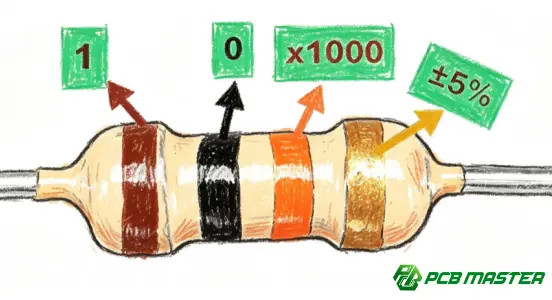
10k Resistor Color Code
For traditional through-hole resistors, the resistance value can be identified using color bands.
A typical 4-band 10k resistor uses:
| Band | Color | Meaning |
|---|---|---|
| 1st | Brown | 1 |
| 2nd | Black | 0 |
| 3rd | Orange | ×1,000 |
| 4th | Depends on tolerance | Tolerance |
Therefore:
10 × 1,000 = 10,000 Ω = 10 kΩ
A 5-band resistor uses a different color-band interpretation because it provides three significant digits before the multiplier.
For modern surface-mount devices, however, resistor values are generally identified through SMD marking codes or, more reliably, the manufacturer's part number and BOM information.
What Is the Difference Between a 10k Resistor and a 10kΩ Resistor?
There is no difference in resistance value .
The following terms describe the same nominal resistance:
- 10k resistor
- 10 kΩ resistor
- 10,000 Ω resistor
- 10K resistor
- 10 kilo-ohm resistor
The notation 10 kΩ is the technically precise form.
When preparing PCB design files, BOMs, and manufacturing documentation, using a consistent notation is important because component values must be unambiguous.
How to Choose the Right 10k Resistor
Selecting a 10k resistor involves more than checking whether its resistance is 10,000 Ω.
Several specifications should be evaluated.
Resistance Tolerance
Tolerance indicates how far the actual resistance can deviate from the nominal value.
For example, a 10k resistor with ±5% tolerance can theoretically have a resistance between:
9.5 kΩ and 10.5 kΩ
A ±1% resistor provides a narrower range:
9.9 kΩ to 10.1 kΩ
For general pull-up and pull-down applications, ±5% may be sufficient. Precision voltage-divider, sensing, and analog applications may require tighter tolerance.
Power Rating
The resistor must also be capable of dissipating the power generated during operation.
Resistor power can be calculated as:
P = I²R
or:
P = V²/R
A common mistake is to focus only on resistance while ignoring power dissipation.
For a 10k resistor with 5 V across it:
P = 5² / 10,000 = 2.5 mW
That is a very small power level.
However, applying a much higher voltage can substantially increase power dissipation. The resistor's rated power must therefore be checked against the actual operating conditions.
Package Size
10k resistors are available in both through-hole and surface-mount packages.
Common SMD package families include:
- 0201
- 0402
- 0603
- 0805
- 1206
The appropriate package depends on:
- PCB space
- Assembly process
- Power requirements
- Voltage rating
- Manufacturing capability
- Reliability requirements
- Inspection and rework requirements
For high-density PCB designs, smaller packages can save board space, but they can also introduce greater assembly and inspection challenges.
Temperature Coefficient
The temperature coefficient of resistance (TCR) describes how resistance changes with temperature.
Precision circuits may require resistors with lower TCR because changes in resistance can directly affect circuit accuracy.
For basic digital pull-up or pull-down applications, TCR may be less critical than it is in precision analog circuits.
10k Resistors in PCB Design and PCBA
A resistor value cannot be evaluated independently from the PCB and PCBA design.
During PCB design, engineers need to consider the resistor's electrical function, package footprint, placement, routing, thermal environment, and assembly requirements.
For example, a 10k pull-up resistor connected to a microcontroller input may require very different design considerations from a 10k resistor used in a precision analog voltage divider.
Common PCB Design Considerations
| Design Factor | What to Consider |
|---|---|
| Resistance | Confirm the required nominal value |
| Tolerance | Determine required circuit accuracy |
| Power rating | Verify maximum operating dissipation |
| Package | Match the PCB footprint and assembly process |
| Voltage rating | Ensure the applied voltage is within specification |
| TCR | Evaluate temperature-related resistance changes |
| Placement | Minimize unwanted noise and parasitic effects |
| BOM | Specify manufacturer/part number when necessary |
| DFM | Confirm manufacturability before production |
Common Mistakes When Using 10k Resistors
Assuming 10k Is Always the Correct Value
10k is common, but common does not mean universally appropriate .
A pull-up resistor may require a different value depending on bus speed, capacitance, leakage current, voltage level, and required rise time.
Similarly, a voltage-divider application must consider the impedance requirements of the circuit receiving the divided voltage.
Ignoring Resistor Tolerance
A circuit requiring accurate voltage measurement may not perform as expected if a resistor with excessive tolerance is selected.
For precision applications, the tolerance of both resistors in a voltage divider may affect the final output accuracy.
Selecting the Package Only by Physical Size
The smallest available package is not automatically the best choice.
Engineers should consider electrical ratings, manufacturing capability, assembly yield, inspection, rework, and long-term reliability.
Treating the BOM and PCB Footprint as Independent
A mismatch between the specified component and PCB footprint can create assembly problems.
The resistance value, package, footprint, component orientation, and BOM part number should be verified as part of the engineering review process.
10k Resistors: Through-Hole vs. SMD
Both through-hole and surface-mount 10k resistors are widely used.
| Feature | Through-Hole 10k Resistor | SMD 10k Resistor |
|---|---|---|
| PCB mounting | Leads through PCB holes | Mounted directly on pads |
| Board density | Lower | Higher |
| Automated SMT assembly | Generally unsuitable | Highly suitable |
| Manual prototyping | Convenient | Possible but more challenging at very small sizes |
| Package size | Larger | Very compact |
| Typical application | Prototypes, power/control circuits | Modern high-density PCB assemblies |
For high-volume electronic manufacturing, SMD resistors are particularly suitable for automated SMT assembly .
How PCB Manufacturing Quality Affects Resistor Assembly
A resistor may be a small component, but its reliable operation depends partly on PCB manufacturing and assembly quality.
Factors such as:
- Pad geometry
- Solder-mask definition
- PCB surface finish
- Component placement accuracy
- Solder-paste printing
- Reflow profile
- AOI inspection
- Electrical testing
can all influence assembly quality.
For complex PCBA projects, engineering review before manufacturing can help identify potential problems before they reach production.
How PCBMASTER Approaches 10k Resistor-Based PCB Projects
For PCB and PCBA projects involving components such as 10k resistors, the component itself is only one part of the manufacturing equation.
PCBMASTER provides PCB, PCBA, and SMT services covering prototype development through production. Its engineering support includes free engineering file review , allowing potential manufacturability, performance, and cost issues to be identified before production.
For customers developing boards with large numbers of passive components, component placement and SMT manufacturing consistency become particularly important. PCBMASTER operates its own 80,000 m² factory and provides PCB manufacturing, assembly, component sourcing, and engineering support within a one-stop production system.
Its quality system is supported by ISO 9001, IATF 16949, UL, and RoHS certifications , while PCB and PCBA products undergo quality-control and testing processes before shipment.
Practical Checklist for Selecting a 10k Resistor
Before releasing a PCB design for manufacturing, engineers can verify the following:
Electrical
- Resistance = 10 kΩ
- Required tolerance confirmed
- Power rating sufficient
- Voltage rating sufficient
- TCR appropriate for the application
PCB Design
- Correct footprint selected
- Pad dimensions verified
- Component clearance checked
- Placement appropriate for the circuit function
- BOM and schematic values match
Manufacturing
- Component availability confirmed
- SMT package compatible with the assembly process
- PCB design reviewed for manufacturability
- Inspection requirements established
- Electrical testing requirements defined
10k Resistors: Key Takeaways
A 10k resistor is a 10,000-ohm resistor , but its practical function depends on how it is integrated into the circuit.
The most common applications include pull-up and pull-down networks, voltage dividers, transistor control, sensor interfaces, and digital logic circuits .
Choosing the right 10k resistor requires consideration of more than resistance value. Tolerance, power rating, voltage rating, TCR, package size, PCB footprint, and assembly requirements can all affect circuit performance and manufacturing reliability.
For PCB and PCBA projects, engineers should also evaluate the complete manufacturing process rather than treating the resistor as an isolated component. Proper BOM verification, DFM review, SMT process control, inspection, and testing contribute to reliable final assemblies.
As PCB designs become increasingly compact and functionally complex, even simple passive components such as 10k resistors need to be considered within the broader context of electrical design, PCB layout, component sourcing, and PCBA manufacturing . This system-level approach helps reduce manufacturing risks and supports more consistent production results.
Tags: #10kResistor #10kOhmResistor #Resistor #Resistors #PCBDesign #PCBA #SMT #PCBManufacturing #ElectronicComponents #CircuitDesign #PCBMASTER #ElectronicsEngineering
About the Author

Carol Luo
PCB Design EngineerI'm Carol, a PCB Engineer at PCBMASTER with experience in PCB design and manufacturing engineering since 2018. I focus on translating engineering requirements into reliable PCB solutions, with expertise in stack-up design, material selection, and design-for-manufacturing (DFM). I share practical engineering insights from real-world PCB design and production experience.
Visit Carol Luo's Profile