








1k Resistor Color Code Explained: How to Read Color Bands, Chart, Tolerance & PCB Applications
The 1kΩ ( 1,000 ohm ) resistor is one of the most common passive components used in electronic circuits and printed circuit boards ( PCBs ) . If you are designing a microcontroller circuit, building an LED driver, or manufacturing industrial control systems, understanding the 1k resistor color code is essential for correctly identifying and troubleshooting components.
Learn how to read 4 band, 5 band and 6 band 1k resistor color codes, understand tolerance and temperature coefficient, know where 1k resistors are used in PCB and PCBA. It provides practical tips for selection and industry best practices in PCB manufacturing and assembly that PCBMASTER applies.
What Is a 1k Resistor?
A 1k resistor has a resistance of 1,000 ohms (Ω), or 1 kilo-ohm (kΩ).
Its main function is to:
- Limit current
- Divide voltage
- Protect electronic components
- Provide pull-up or pull-down resistance
- Set amplifier gain
- Bias transistors and MOSFETs
- Filter analog and digital signals
The 1k resistor is ubiquitous, found in almost every type of electronic product due to its versatility including:
- Consumer electronics
- Automotive electronics
- Industrial automation
- Medical devices
- Communication equipment
- IoT products
- Power supplies
- Embedded systems
How to Read a 1k Resistor Color Code
Instead of a resistance value printed on the resistor , it has colored bands .
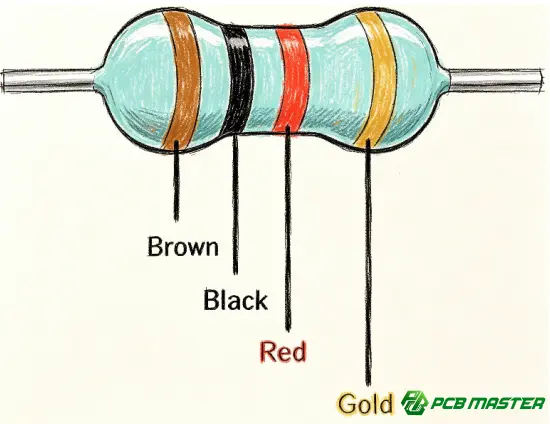
4-Band 1k Resistor Color Code
The common 1kΩ ±5% resistor has 4 color bands.
| Band | Color | Meaning |
|---|---|---|
| 1 | Brown | 1 |
| 2 | Black | 0 |
| 3 | Red | ×100 |
| 4 | Gold | ±5% |
Color sequence:
Brown – Black – Red – Gold
Calculation:
- First digits = 10
- Multiplier = ×100
10 × 100 = 1000Ω
5-Band 1k Resistor Color Code
Higher precision resistors usually have five bands.
| Band | Color | Meaning |
|---|---|---|
| 1 | Brown | 1 |
| 2 | Black | 0 |
| 3 | Black | 0 |
| 4 | Brown | ×10 |
| 5 | Brown | ±1% |
Color sequence:
Brown – Black – Black – Brown – Brown
Calculation:
100 × 10 = 1000Ω
6-Band 1k Resistor Color Code
Six-band resistors have a sixth band indicating the Temperature Coefficient (TCR) .
Example:
Brown – Black – Black – Brown – Brown – Brown
| Band | Function |
|---|---|
| First 3 | Significant digits |
| Fourth | Multiplier |
| Fifth | Tolerance |
| Sixth | Temperature coefficient |
Six-band resistors are commonly used in:
- Precision instrumentation
- Medical electronics
- Aerospace equipment
- Industrial control systems
- Automotive ECUs
1k Resistor Color Code Chart
| Resistance | 4-Band | 5-Band | Typical Tolerance |
|---|---|---|---|
| 1kΩ | Brown-Black-Red-Gold | Brown-Black-Black-Brown-Brown | ±5%, ±1% |
| 1kΩ | Brown-Black-Red-Silver | Brown-Black-Black-Brown-Red | ±10%, ±2% |
Understanding Resistor Tolerance
The tolerance is the allowable deviation of the actual resistance from its nominal value.
| Color | Tolerance |
|---|---|
| Brown | ±1% |
| Red | ±2% |
| Gold | ±5% |
| Silver | ±10% |
| None | ±20% |
Example:
A 1kΩ ±5% resistor may measure anywhere between:
- 950Ω
- 1050Ω
For high precision analogue circuits, designers frequently opt for ±1% metal film resistors, which offer improved accuracy and stability.
Power Ratings of 1k Resistors
Power rating and resistance value are two different specifications.
Typical power ratings are:
| Power Rating | Typical Applications |
|---|---|
| 1/8W | Compact consumer electronics |
| 1/4W | General-purpose PCB circuits |
| 1/2W | Power management |
| 1W | Industrial equipment |
| 2W+ | High-current applications |
Engineers need to make sure the resistor dissipates more power than the expected load, otherwise it will overheat and fail.
Common PCB Applications for 1k Resistors
The 1k resistor is used in many PCB designs because of its balanced resistance value.
LED Current Limiting
One of the most common applications is to limit current through LEDs.
Benefits include:
- Prevents LED burnout
- Controls brightness
- Protects microcontroller GPIO pins
Pull-Up and Pull-Down Networks
Stable logic levels are necessary for digital circuits.
10kΩ is the most common choice, but 1kΩ may be chosen when:
- Faster signal transitions are required
- Stronger pull-up strength is needed
- High-noise industrial environments demand improved signal integrity
Voltage Divider Circuits
Two 1k resistors can create a simple voltage divider for:
- Analog sensing
- ADC reference circuits
- Signal conditioning
- Sensor interfaces
Transistor Biasing
Often a 1k resistor is used to limit base current in bipolar junction transistor (BJT) circuits, which helps control switching characteristics and protects the transistor and the driving source.
Current Sensing and Protection
1k precision resistors are used in power electronics in:
- Feedback loops
- Protection circuits
- Comparator networks
- Operational amplifier configurations
Carbon Film vs. Metal Film 1k Resistors
| Feature | Carbon Film | Metal Film |
|---|---|---|
| Accuracy | Lower | Higher |
| Noise | Higher | Lower |
| Temperature Stability | Moderate | Excellent |
| Cost | Lower | Slightly Higher |
| Precision Circuits | Not Ideal | Recommended |
| Industrial Applications | Limited | Widely Used |
For professional PCB assemblies, metal film resistors are usually the choice, as they have tighter tolerance, better stability and lower electric noise.
How to Verify a 1k Resistor
Technicians should check resistor values on a PCB with a digital multimeter before soldering components to the board.
Best practices include:
- Read the color bands.
- Confirm the resistance with a multimeter.
- Verify the tolerance specification.
- Check the resistor's power rating.
- Inspect for physical damage or contamination before assembly.
These simple verification checks can help prevent assembly errors and improve first-pass manufacturing yield.
Common Mistakes When Reading Resistor Color Codes
Reading from the Wrong End
Always start at the end away from the tolerance band which is normally gold or silver or furthest from the other bands.
Confusing Red and Orange
Bad lighting can make neighbouring colors hard to tell apart. The errors of identification may be reduced by adequate inspection lighting or optical inspection equipment.
Ignoring Tolerance
Two resistors of the same nominal resistance but with different tolerances may behave differently in precision circuits.
Assuming Every 1k Resistor Is Identical
Resistors having equal resistance values may have variations in:
- Tolerance
- Power rating
- Temperature coefficient
- Package size
- Material type
- Voltage rating
The correct specification is critical to the correct operation of the circuit.
PCBMASTER's Best Practices for Reliable PCB Assembly
The proper selection of resistors is one part of the total job of providing reliable electronic products. PCBMASTER provides complete quality control in PCB manufacturing and PCBA assembly to guarantee the same level of component placement, soldering quality and electrical performance.
PCBMASTER is ISO 9001, IATF 16949, UL and RoHS certified manufacturer, providing one-stop services of PCB fabrication, component sourcing, SMT assembly and testing for customers in automotive, industrial, communications, medical and consumer electronics industries.
To support high manufacturing yields and dependable product quality, PCBMASTER offers:
- Free engineering file review and DFM analysis before production
- Advanced AOI inspection and multiple quality inspection stages
- Quick-turn PCB prototyping with rapid production scheduling
- Support for HDI, rigid-flex, flexible PCBs, high-frequency boards, and metal-core PCBs
- Professional engineering support from design verification through final assembly
These practices help reduce the assembly defects, improve manufacturability and speed the product development from prototype to volume production.
Conclusion
Knowing the 1k resistor color code is a basic skill for anyone who works with electronics. Whether you are reading a Brown-Black-Red-Gold 4-band resistor or a precision 5-band version, reading the color bands correctly helps to avoid design mistakes, assembly errors and costly troubleshooting.
In professional PCB manufacturing, accurate identification of components must always be associated with diligent quality control, engineering validation and dependable assembly operations. Engineers can achieve higher product reliability, greater manufacturing efficiency, and long-term circuit performance through proper resistor selection and disciplined PCB production practices.
Tags: #1kResistor #ResistorColorCode #PCB #PCBA #SMT #Electronics #CircuitDesign #PCBAssembly #ElectronicComponents #PCBMASTER #DFM #Manufacturing #ElectricalEngineering #EmbeddedSystems #HardwareDesign
About the Author

Carol Luo
PCB Design EngineerI'm Carol, a PCB Engineer at PCBMASTER with experience in PCB design and manufacturing engineering since 2018. I focus on translating engineering requirements into reliable PCB solutions, with expertise in stack-up design, material selection, and design-for-manufacturing (DFM). I share practical engineering insights from real-world PCB design and production experience.
Visit Carol Luo's Profile