








100 Ohm Resistor Color Code: Complete Guide to Reading 100Ω Resistors
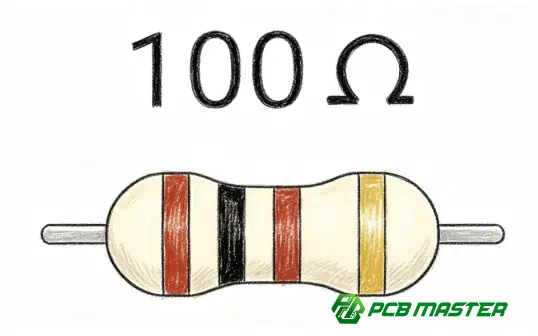
The 100 ohm resistor colour code is one of the most common resistor markings used in electrical equipments, PCB assembly and electronic circuits. A typical 4-band resistor is Brown – Black – Brown – Gold , which means 100Ω ±5% This helps engineers, technicians and hobbyists to easily identify the value of the resistor, prevent assembly errors and maintain the reliability of the circuit.
What Is the Color Code for a 100 Ohm Resistor?
Resistors are marked with colour bands to indicate the resistance, multiplier and tolerance. This is based on an international standard called the resistor colour code.
The most common colour code for 100Ω resistors is:
| Resistor Type | Color Bands | Resistance | Tolerance |
|---|---|---|---|
| 4-Band | Brown – Black – Brown – Gold | 100Ω | ±5% |
| 4-Band | Brown – Black – Brown – Silver | 100Ω | ±10% |
| 5-Band | Brown – Black – Black – Black – Brown | 100Ω | ±1% |
| 5-Band | Brown – Black – Black – Black – Red | 100Ω | ±2% |
How to Read a 4-Band 100 Ohm Resistor
This is how a typical 4 band resistor looks like:
- 1st Band: First significant digit
- 2nd Band: Second significant digit
- 3rd Band: Multiplier
- 4th Band: Tolerance
For a 100Ω ±5% resistor :
| Band | Color | Meaning |
|---|---|---|
| 1 | Brown | 1 |
| 2 | Black | 0 |
| 3 | Brown | ×10 |
| 4 | Gold | ±5% |
Calculation:
10 × 10 = 100Ω
Tolerance = ±5%
Therefore:
Brown – Black – Brown – Gold = 100Ω ±5%
How to Read a 5-Band 100 Ohm Resistor
Five color bands are used for more accurate resistors.
Example:
Brown – Black – Black – Black – Brown
| Band | Meaning |
|---|---|
| Brown | 1 |
| Black | 0 |
| Black | 0 |
| Black | ×1 |
| Brown | ±1% |
Calculation:
100 × 1 = 100Ω
Result:
100Ω ±1%
Resistor Color Code Reference
| Color | Digit | Multiplier | Tolerance |
|---|---|---|---|
| Black | 0 | ×1 | — |
| Brown | 1 | ×10 | ±1% |
| Red | 2 | ×100 | ±2% |
| Orange | 3 | ×1,000 | — |
| Yellow | 4 | ×10,000 | — |
| Green | 5 | ×100,000 | ±0.5% |
| Blue | 6 | ×1,000,000 | ±0.25% |
| Violet | 7 | ×10,000,000 | ±0.1% |
| Gray | 8 | ×100,000,000 | ±0.05% |
| White | 9 | ×1,000,000,000 | — |
| Gold | — | ×0.1 | ±5% |
| Silver | — | ×0.01 | ±10% |
Where Are 100Ω Resistors Used?
A 100-ohm resistor is widely used in electronic design and PCB manufacturing, including:
- Current limiting for LEDs
- Signal conditioning circuits
- Pull-up and pull-down resistor networks
- Termination in communication interfaces
- Voltage divider circuits
- Microcontroller GPIO protection
- Analog and digital PCB designs
The 100Ω Resistor is a versatile component, and can be used in consumer electronics, industrial automation, automotive electronics, communication equipment and IoT devices.
Common Mistakes When Reading Resistor Color Codes
Reading the Resistor Backwards
On the right hand side will be the tolerance band (usually Gold or Silver). If you read it from the wrong end you will get an incorrect resistance value.
Confusing Brown and Red
Brown represents 1 , while Red represents 2 . Misidentifying these colors can cause a large variation in the calculated resistance.
Mixing 4-Band and 5-Band Resistors
A 5-band resistor has three significant digits, while a 4-band resistor has two. Check the value and always count bands.
Why Accurate Resistor Identification Matters in PCB Assembly
The selection of the proper value of resistor is critical to the operation, signal integrity and long term reliability of the circuit. Poor resistor installation can cause voltage errors, high current, unstable operation or complete circuit failure.
Professional PCB assembly manufacturers utilize engineering review, automated optical inspection (AOI) and electrical testing to check component values and reduce assembly errors. PCBMASTER provides component verification and complete quality control for complex PCB and PCBA projects, helping customers achieve reliable production from prototype to mass manufacturing.
Conclusion
Once you know the resistor colour code system, the 100 ohm resistor colour code is simple. The most common code is Brown-Black-Brown-Gold for 100 ohms ±5%. The 5 band code Brown-Black-Black-Black-Brown is often used for precision resistors to indicate a tolerance of ±1%.
Knowing the resistor colour codes well improves the accuracy of the assembly and helps to ensure that the circuit performs reliably. Be it designing a PCB, debug electronic circuits or build a prototype.
Tags: #100OhmResistor #ResistorColorCode #Electronics #PCB #PCBA #SMT #CircuitDesign #PCBMASTER #ElectronicComponents #Engineering
About the Author

Carol Luo
PCB Design EngineerI'm Carol, a PCB Engineer at PCBMASTER with experience in PCB design and manufacturing engineering since 2018. I focus on translating engineering requirements into reliable PCB solutions, with expertise in stack-up design, material selection, and design-for-manufacturing (DFM). I share practical engineering insights from real-world PCB design and production experience.
Visit Carol Luo's Profile