








What Is a Shunt Resistor? A Complete Guide to Current Sensing in Electronic Circuits
Shunt resistors are precision low resistance resistor for measurement of electric current. The shunt resistor has a small voltage drop proportional to the current flowing through it. Ohm’s Law helps engineers to find the current accurately without breaking the circuit. Shunt resistors are the most popular current sensing component used in power electronics, automotive, battery management systems (BMS) , industrial equipment, renewable energy and consumer electronics. You need to think a bit about selecting the correct shunt resistor, resistance value, power rating, tolerance, temperature coefficient and PCB layout. Manufacturers like PCBMASTER offer high quality PCB fabrication, PCBA assembly and engineering support for current sensing applications to help ensure reliable performance.
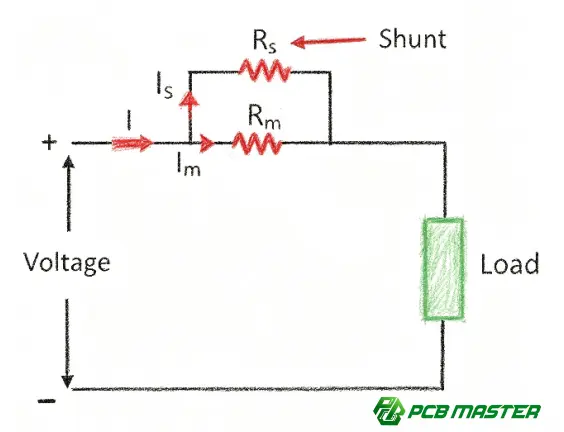
What Is a Shunt Resistor?
A shunt resistor (also called current shunt or current-sense resistor) is a resistor with a very low resistance value, typically in the range of 0.1 mΩ to a few hundred mΩ. It is in series with the load so that all the current goes through it.
Knowing the resistance of the resistor we can measure the voltage drop across it and from that determine the current.
Ohm’s Law gives this relationship:
I=V/R
Where:
- I = Current (A)
- V = Voltage across the shunt resistor (V)
- R = Resistance (Ω)
For example:
- Shunt resistance = 5 mΩ
- Measured voltage = 50 mV
Current:
I=0.05/0.005=10A
This simple principle makes shunt resistors to be among the most accurate and cheapest solutions for current measurement .
Why Are Shunt Resistors Used?
In almost all electronic systems it is necessary to measure current.
Shunt resistors have several important functions:
- Current monitoring
- Overcurrent protection
- Battery charging management
- Motor control
- Power monitoring
- Energy metering
- Load balancing
- Efficiency optimization
The advantages of shunt resistors over hall effect sensors or current transformers are:
- High accuracy
- Excellent linearity
- Low cost
- Wide bandwidth
- Small size
- Simple implementation
How Does a Shunt Resistor Work?
A shunt resistor has a very small voltage drop but dissipates most of the power to the load.
This small voltage is then sensed by the sensing amplifier or ADC.
Then the controller changes voltage into current.
Example of signal chain:
Power Source
│
│
Shunt Resistor
│
├────► Current Sense Amplifier
│
├────► ADC
│
├────► MCU / DSP
│
Load
The resistance is so small that the loss of power is very small and the accuracy of measurement is kept.
Types of Shunt Resistors
Surface-Mount (SMD) Shunt Resistors
Most common option for contemporary PCB designs.
Advantages include:
- Compact size
- Automated assembly
- Good thermal performance
- Suitable for mass production
Typical packages include:
- 0402
- 0603
- 0805
- 1206
- 2512
- 3920
Four-Terminal (Kelvin) Shunt Resistors
Kelvin shunt resistors are employed to isolate the current path from the voltage sensing path.
Benefits include:
- Higher measurement accuracy
- Reduced PCB trace resistance influence
- Better performance at high current
They are widely used in:
- EV battery systems
- Precision power supplies
- Industrial automation
- Medical equipment
Through-Hole Shunt Resistors
These are designed for:
- High-power equipment
- Industrial machinery
- Laboratory instruments
- High-current power systems
They have higher mechanical strength and heat dissipation.
Common Materials Used
The stability and performance of the resistor depends on the material used.
| Material | Advantages | Typical Applications |
|---|---|---|
| Manganin | Extremely low temperature coefficient | Precision measurement |
| Constantan | Stable resistance | Industrial current sensing |
| Metal Alloy | High accuracy | Automotive electronics |
| Nickel-Chromium | High temperature resistance | Power electronics |
| Copper-Manganese Alloy | Excellent stability | BMS and EV systems |
Key Specifications to Consider
To choose the correct shunt resistor, there are many parameters to be taken into account.
| Parameter | Why It Matters |
|---|---|
| Resistance Value | Determines measurable current range |
| Power Rating | Prevents overheating |
| Tolerance | Affects measurement accuracy |
| Temperature Coefficient (TCR) | Improves stability over temperature |
| Maximum Current | Prevents resistor damage |
| Thermal EMF | Important in precision measurement |
| Package Size | Influences heat dissipation |
| Pulse Capability | Handles surge currents |
PCB Design Considerations
The correct PCB layout has a great impact on the accuracy of the current measurement.
Use Kelvin Connections
Kelvin sensing removes voltage errors from PCB trace resistance.
Keep Sense Traces Short
The long traces cause the additional noise and voltage offsets.
Separate Power and Signal Paths
High current traces should not interfere with sensitive measurement circuits.
Increase Copper Area
The shunt resistor creates heat and large copper pours help dissipate it.
Minimize Thermal Gradients
Resistance changes with uneven heating so it’s less accurate.
Place the Amplifier Nearby
Positioning the current sense amplifier close to the resistor reduces the noise in the signal.
Applications of Shunt Resistors
The shunt resistors are used in almost all the fields of electronics industry.
| Industry | Typical Applications |
|---|---|
| Automotive | Battery Management Systems (BMS), OBC, DC/DC converters, motor controllers |
| Renewable Energy | Solar inverters, energy storage systems |
| Industrial Automation | Motor drives, PLCs, power supplies |
| Consumer Electronics | Chargers, laptops, smartphones |
| Medical Equipment | Precision monitoring systems |
| Telecommunications | Power distribution equipment |
| Electric Vehicles | Battery monitoring and current protection |
Shunt Resistor vs Hall Effect Sensor
| Feature | Shunt Resistor | Hall Effect Sensor |
|---|---|---|
| Accuracy | Excellent | Good |
| Cost | Low | Higher |
| Isolation | No | Yes |
| Bandwidth | Very High | Moderate |
| Power Loss | Small | Nearly None |
| Temperature Stability | Excellent | Moderate |
| High Current Measurement | Good | Excellent |
Shunt resistors are still the most preferred solution for low to medium voltage high precision applications.
Common Design Mistakes
Engineers frequently encounter these issues:
- Selecting an insufficient power rating
- Ignoring resistor self-heating
- Poor PCB layout
- Not using Kelvin sensing
- Choosing excessive resistance values
- Long differential sensing traces
- Placing noisy switching circuits too close to sensing lines
Avoiding these mistakes is a good way to improve the accuracy of your measurements and the reliability of your results over the long-term.
PCBMASTER's Experience in Current-Sensing PCB Manufacturing
When designing PCBs for shunt resistor applications, important factors to be considered are copper thickness, current carrying capacity, thermal management and signal integrity. PCBMASTER provides full service PCB and PCBA manufacturing to support engineers throughout the entire process.
PCBMASTER has a plant of 80,000㎡, which is equipped with:
- PCB fabrication from prototypes to volume production
- HDI, high-frequency, rigid-flex, FPC, and metal-core PCBs
- Free engineering file review and DFM analysis
- Advanced AOI inspection and multiple quality inspections
- ISO 9001, IATF 16949, UL, and RoHS compliant manufacturing
- 24-hour prototype service and rapid production scheduling
- 99.59% on-time delivery with global logistics support
These capabilities allow customers to design robust current sensing circuits for automotive electronics, industrial automation, renewable energy, telecommunications and other demanding applications.
Future Trends
Present sensing technology is developed by using modern power electronics.
Emerging trends include:
- Ultra-low resistance metal alloy shunts
- Higher power density designs
- Integrated current sensing modules
- AI-assisted power management
- Wide-bandgap semiconductor applications
- Higher precision battery monitoring
- Increased adoption in electric vehicles and energy storage systems
As electronic systems require ever higher efficiency and accuracy, shunt resistors will remain important for reliable current measurement.
Conclusion
Shunt resistors are a very good and accurate way to measure electrical current in a cost-effective way. Thanks to the simple operating principle, excellent linearity and wide application range, they are indispensable in industries ranging from consumer electronic products to electric vehicles and industrial automation.
Its not just a matter of choosing the right resistor specs, it will be the PCB layout, thermal management and manufacturing quality that will make or break it. Good engineering and the right manufacturing partner like PCBMASTER help designers to achieve accurate current measurement and long-term system reliability.
Tags: #ShuntResistor #CurrentSense #PCB #PCBA #SMT #Electronics #AutomotiveElectronics #BatteryManagementSystem #PowerElectronics #PCBMASTER #Manufacturing #ElectronicDesign #CurrentMeasurement #IndustrialAutomation #IndustryInsights
About the Author

Carol Luo
PCB Design EngineerI'm Carol, a PCB Engineer at PCBMASTER with experience in PCB design and manufacturing engineering since 2018. I focus on translating engineering requirements into reliable PCB solutions, with expertise in stack-up design, material selection, and design-for-manufacturing (DFM). I share practical engineering insights from real-world PCB design and production experience.
Visit Carol Luo's Profile