








What Does a Capacitor Do? A Practical Guide to Capacitors in Electronic Circuits
A capacitor is a passive electronic component that stores electrical energy in an electric field and releases it when needed . In practical circuits, capacitors are widely used for filtering, decoupling, energy buffering, timing, coupling, and voltage stabilization. Their behavior depends on capacitance, voltage rating, dielectric material, ESR, frequency, and package characteristics. Understanding what a capacitor does is essential for PCB design, power electronics, signal processing, and PCBA manufacturing.
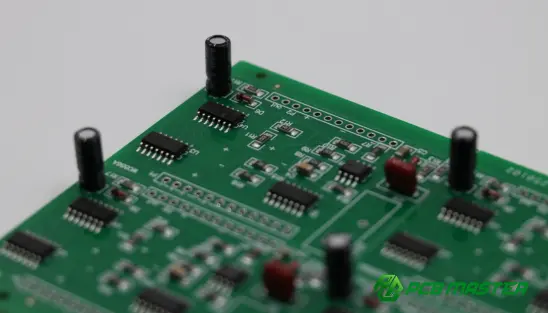
What Does a Capacitor Do?
The primary function of a capacitor is to store and release electrical charge .
A capacitor consists of two conductive plates separated by an insulating material called a dielectric . When voltage is applied, electrical charge accumulates on the plates, creating an electric field between them.
The relationship between charge, capacitance, and voltage is:
Q=CV
where:
- Q = stored charge
- C = capacitance
- V = voltage across the capacitor
The energy stored in a capacitor is:
E= ( CV² ) /2
This stored energy can subsequently be released into the circuit.
However, saying that a capacitor simply "stores electricity" does not fully explain its role in real electronic systems. A capacitor's ability to respond differently to DC and changing signals makes it useful for many circuit functions.
How Does a Capacitor Behave in a DC Circuit?
When a capacitor is initially connected to a DC voltage source, it allows current to flow while it charges.
As the capacitor approaches the applied voltage, the charging current decreases. Once fully charged under ideal steady-state DC conditions, the capacitor behaves approximately like an open circuit .
This behavior makes capacitors useful for:
- Voltage smoothing
- DC filtering
- Energy storage
- Power supply stabilization
- Transient suppression
How Does a Capacitor Behave With AC Signals?
A capacitor behaves differently when the voltage continuously changes.
Its capacitive reactance is:
XC = 1/( 2πfC )
where:
- XC = capacitive reactance
- f = frequency
- C = capacitance
As frequency increases, capacitive reactance decreases. Therefore, a capacitor generally provides a lower impedance path for higher-frequency signals .
This principle is fundamental to filtering and decoupling circuits.
What Are the Main Functions of a Capacitor?
Different capacitor applications can be grouped into several major functions.
| Function | What the Capacitor Does | Typical Application |
|---|---|---|
| Energy storage | Stores and releases electrical energy | Power supplies |
| Decoupling | Reduces local voltage disturbances | Digital IC power rails |
| Filtering | Attenuates unwanted AC components or noise | Power supplies |
| Smoothing | Reduces voltage ripple | Rectifier circuits |
| Coupling | Passes AC signals while blocking DC | Amplifier stages |
| Timing | Works with resistors to determine time constants | Oscillators and timers |
| Power factor correction | Compensates reactive power | AC power systems |
| Transient suppression | Helps absorb or redirect short-duration disturbances | Switching circuits |
How Do Capacitors Filter Voltage?
One of the most common capacitor applications is voltage filtering .
Power supplies do not always produce perfectly constant DC voltage. Rectification and switching processes can introduce voltage ripple and high-frequency noise.
A capacitor connected across the power rail can absorb some of these voltage variations and release stored energy as the voltage changes.
For example, after an AC voltage is rectified, a capacitor can be placed across the DC output to reduce the resulting ripple.
Capacitors in Power Supply Filtering
In a power supply, capacitor selection depends on several parameters:
- Capacitance
- Rated voltage
- Ripple current
- ESR
- Operating temperature
- Frequency characteristics
- Lifetime requirements
A capacitor with a higher capacitance is not automatically a better choice. The electrical and thermal characteristics of the capacitor must match the circuit's operating conditions.
What Is a Decoupling Capacitor?
A decoupling capacitor is placed close to an integrated circuit or other active device to help maintain a stable local supply voltage.
When a digital IC switches states, its current demand can change very quickly. The PCB's power distribution network has parasitic resistance and inductance, so the power supply cannot always respond instantly.
A nearby capacitor provides a local source of charge during these short transient events.
This helps:
- Reduce supply-voltage fluctuations
- Suppress high-frequency noise
- Reduce power-ground noise
- Improve IC power integrity
- Reduce the impact of transient current demand
Why Is Capacitor Placement Important on a PCB?
For high-speed or high-frequency circuits, capacitor placement can be just as important as capacitor value .
The connection between the capacitor and IC introduces parasitic inductance. Long traces increase the current loop area and can reduce the capacitor's effectiveness at high frequencies.
For this reason, PCB designers typically place high-frequency decoupling capacitors as close as practical to the IC power pins , while also considering the power and ground return paths.
What Does a Capacitor Do in an AC Coupling Circuit?
Capacitors can also be used to block DC while allowing changing signals to pass .
This is called AC coupling .
For example, when two amplifier stages operate at different DC bias levels, a coupling capacitor can transfer the AC signal from one stage to the next without directly transferring the DC bias.
This makes capacitors useful in:
- Audio circuits
- Amplifiers
- Communication equipment
- Analog signal processing
- High-speed signal interfaces
The capacitor and the input impedance of the following circuit can form a high-pass filter , meaning low-frequency components are attenuated while higher-frequency components pass more readily.
What Does a Capacitor Do in a Timing Circuit?
A capacitor can work together with a resistor to create an RC time constant .
For a basic RC circuit:
τ=RC
where:
- τ = time constant
- R = resistance
- C = capacitance
The time constant determines how quickly the capacitor charges or discharges through the resistor.
This principle is used in:
- Timers
- Oscillators
- Delay circuits
- Pulse-shaping circuits
- Filters
- Control circuits
Changing either the resistance or capacitance changes the circuit's timing characteristics.
What Types of Capacitors Are Used on PCBs?
Different capacitor technologies provide different electrical characteristics.
| Capacitor Type | Typical Characteristics | Common PCB Applications |
|---|---|---|
| Ceramic capacitor | Small, low ESR, excellent high-frequency performance | IC decoupling, filtering |
| Aluminum electrolytic | High capacitance and relatively low cost | Power supply filtering |
| Tantalum capacitor | Stable capacitance and compact size | Power management |
| Film capacitor | Good stability and low losses | Power electronics, filtering |
| Supercapacitor | Extremely high capacitance | Energy storage and backup power |
Ceramic Capacitors
Multilayer ceramic capacitors (MLCCs) are extremely common on modern PCBs.
Their compact size, low ESR, and favorable high-frequency characteristics make them particularly useful for IC decoupling and high-frequency filtering.
However, designers need to consider factors such as:
- DC bias
- Temperature characteristics
- Voltage rating
- Mechanical stress
- Capacitance tolerance
The nominal capacitance printed in a component specification does not necessarily represent the effective capacitance under every operating condition.
How Do You Choose the Right Capacitor?
Choosing a capacitor requires more than selecting a capacitance value.
At minimum, engineers should evaluate the following parameters:
1. Capacitance
The required capacitance depends on the circuit function.
A decoupling capacitor, bulk power capacitor, timing capacitor, and signal-coupling capacitor may all require very different capacitance values.
2. Voltage Rating
The capacitor's rated voltage should provide sufficient margin above the maximum voltage expected in the application.
Using a capacitor too close to its voltage limit can compromise reliability.
3. ESR
Equivalent Series Resistance (ESR) becomes particularly important in power applications.
High ESR can increase power dissipation and reduce filtering performance.
4. Ripple Current
For capacitors exposed to significant AC ripple current, the ripple-current rating must be appropriate for the application.
5. Temperature
Temperature affects capacitance, ESR, leakage current, lifetime, and reliability.
Automotive, industrial, and high-power electronics often require careful temperature analysis.
6. Package and PCB Footprint
The capacitor must be compatible with the PCB footprint, assembly process, mechanical constraints, and available board space.
For SMT assembly, package selection also affects placement, soldering, inspection, and manufacturing yield.
Common Capacitor Design Mistakes
Several capacitor-selection mistakes can create problems even when the nominal capacitance appears correct.
Mistake 1: Choosing Based Only on Capacitance
A 10 µF capacitor is not necessarily equivalent to another 10 µF capacitor .
Voltage rating, dielectric type, ESR, temperature characteristics, tolerance, and frequency behavior can all differ.
Mistake 2: Ignoring DC Bias
Some ceramic capacitors experience significant capacitance reduction as DC voltage increases.
Therefore, engineers should check the manufacturer's capacitance-versus-voltage characteristics when designing sensitive circuits.
Mistake 3: Poor PCB Placement
A theoretically appropriate capacitor can become less effective if it is connected to the IC through unnecessarily long traces.
Mistake 4: Ignoring Manufacturing Constraints
Component selection should also consider PCB assembly requirements, pad geometry, component availability, soldering conditions, and inspection.
A technically valid circuit design still needs to be manufacturable and reliable at production scale .
How Capacitors Affect PCB Design and Manufacturing
Capacitors are small components, but their placement and electrical characteristics can have a significant impact on PCB performance.
For high-speed, RF, automotive, industrial, and power electronics applications, engineers need to consider capacitor selection together with:
- PCB stack-up
- Power distribution
- Ground-plane design
- Trace impedance
- Thermal management
- Component placement
- Assembly process
- Testing requirements
This is where PCB design and manufacturing engineering need to work together.
For example, PCBMASTER provides free engineering file checking , allowing potential manufacturability, performance, and cost issues to be identified before production. Its PCB and PCBA capabilities cover applications ranging from standard boards to HDI, high-frequency, FPC, rigid-flex, and metal-core PCBs.
Capacitors in Different Electronic Applications
The function of a capacitor varies depending on the application.
| Application | Typical Capacitor Role |
|---|---|
| Consumer electronics | Filtering and decoupling |
| Automotive electronics | Power stabilization and transient filtering |
| Industrial control | Filtering, timing, and energy buffering |
| Communication equipment | Signal coupling and high-frequency filtering |
| Power electronics | DC-link filtering and energy storage |
| Computers and servers | High-speed power decoupling |
| Battery systems | Filtering and power stabilization |
| Medical electronics | Power filtering and signal conditioning |
The required capacitor technology therefore depends heavily on electrical requirements, operating environment, PCB architecture, and reliability targets .
Practical Engineering Checklist
Before approving a capacitor for a PCB design, verify:
- Capacitance: Does the effective capacitance meet the circuit requirement?
- Voltage: Is the voltage rating sufficiently above the operating voltage?
- Frequency: Does the capacitor perform adequately at the target frequency?
- ESR: Is the ESR appropriate for the application?
- Ripple current: Can it handle the expected ripple?
- Temperature: Is its operating temperature range suitable?
- Footprint: Is the PCB land pattern correct?
- Placement: Is the capacitor positioned appropriately relative to the circuit?
- Availability: Can the component be sourced consistently?
- Assembly: Is the component compatible with the intended PCBA process?
PCBMASTER's Approach to Reliable PCB and PCBA Production
As a PCB and PCBA manufacturer serving electronics applications across multiple industries, PCBMASTER combines PCB fabrication, PCBA assembly, engineering support, and manufacturing capabilities within its own 80,000 m² factory .
Its engineering team provides free document checking before production, helping identify potential design and manufacturability issues before they become manufacturing problems. This is particularly useful for boards containing dense SMT components, high-speed interfaces, HDI structures, or demanding power-management circuits.
Quality control is supported by ISO 9001, IATF 16949, UL, and RoHS certifications , together with PCB testing and inspection processes. For applications where component placement, power integrity, and manufacturing consistency are critical, integrating engineering review with PCB and PCBA production can reduce avoidable design-to-manufacturing risks.
Conclusion: What Does a Capacitor Do?
A capacitor stores electrical energy and responds to changes in voltage , but its practical role extends far beyond simple energy storage.
Depending on the circuit, a capacitor can:
- Filter unwanted noise
- Smooth DC voltage
- Decouple IC power supplies
- Couple AC signals
- Create timing functions
- Buffer transient current
- Store energy
- Support power-management circuits
The correct capacitor depends on more than its capacitance value. Voltage rating, effective capacitance, ESR, frequency response, temperature, package, PCB placement, and manufacturing requirements all influence real-world performance.
For PCB designers and electronics engineers, understanding these parameters is essential when moving from a schematic to a reliable, manufacturable PCB or PCBA.
Frequently Asked Questions
1. What is the main purpose of a capacitor?
A capacitor primarily stores and releases electrical energy. In electronic circuits, it is also widely used for filtering, decoupling, coupling, timing, and voltage stabilization.
2. Does a capacitor allow DC current to pass?
A capacitor initially allows current to flow while charging. Under ideal steady-state DC conditions, it eventually behaves approximately like an open circuit.
3. Why are capacitors placed near ICs?
They provide a local source of charge during rapid changes in IC current demand and help reduce high-frequency power-supply noise and voltage fluctuations.
4. What happens if a capacitor has too low a voltage rating?
The capacitor may experience excessive electrical stress, potentially resulting in degradation or failure. The selected voltage rating should provide appropriate margin for the application's maximum voltage.
5. Are all capacitors with the same capacitance equivalent?
No. Capacitors with the same nominal capacitance can have very different ESR, voltage ratings, dielectric characteristics, temperature behavior, tolerances, and frequency performance.
Tags: #Capacitor #Capacitors #PCB #PCBA #Electronics #CircuitDesign #PCBDesign #SMT #PowerElectronics #ElectronicComponents #PCBManufacturing #EngineeringInsights
About the Author

Carol Luo
PCB Design EngineerI'm Carol, a PCB Engineer at PCBMASTER with experience in PCB design and manufacturing engineering since 2018. I focus on translating engineering requirements into reliable PCB solutions, with expertise in stack-up design, material selection, and design-for-manufacturing (DFM). I share practical engineering insights from real-world PCB design and production experience.
Visit Carol Luo's Profile