








Capacitor Stores Energy In: Understanding How Electrical Energy Is Stored
A capacitor stores electrical energy in the electric field between its conductive plates . When a voltage is applied, opposite charges accumulate on the two conductors, creating an electric field in the dielectric. The stored energy is determined by capacitance and voltage according to E = ½CV² . Understanding where and how this energy is stored is fundamental to capacitor selection, PCB power integrity, filtering, timing circuits, and energy-storage applications.
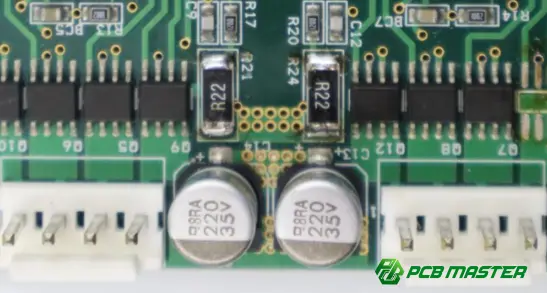
Where Does a Capacitor Store Energy?
A capacitor stores energy in the electric field established between its conductive electrodes , rather than simply “inside the plates.”
A basic capacitor consists of two conductive plates separated by an insulating material called a dielectric . When connected to a voltage source, electrons accumulate on one plate while the other plate becomes relatively positive. This separation of charge produces an electric field across the dielectric.
The energy associated with this electric field is the energy stored by the capacitor.
For an ideal capacitor:
E = ½CV²
Where:
- E = stored energy in joules (J)
- C = capacitance in farads (F)
- V = voltage across the capacitor in volts (V)
This equation also explains why capacitor voltage rating is important. Because stored energy increases with the square of voltage , doubling the voltage increases the stored energy by a factor of four if capacitance remains unchanged.
What Role Does the Dielectric Play?
The dielectric does not simply act as a physical separator. Its electrical properties directly influence the capacitor's behavior.
The dielectric's relative permittivity affects how much capacitance can be achieved for a given physical structure. In practical capacitors, dielectric characteristics also influence leakage current, voltage dependence, temperature stability, breakdown strength, and frequency performance.
For PCB applications, these characteristics matter because the capacitor may be used for decoupling, filtering, energy buffering, timing, or transient suppression rather than simply as a theoretical energy-storage component.
How Is Energy Stored in a Capacitor?
Consider a capacitor initially at 0 V.
As a voltage source begins charging it, electrical work is required to move additional charge onto the plates. The required voltage increases as more charge accumulates.
The relationship is:
Q = CV
The incremental work required to move charge onto the capacitor can be integrated to obtain:
E = ½CV²
This means the capacitor does not store energy because it contains a permanent supply of electrons. Instead, energy is associated with the electrostatic field created by the separated charges .
Capacitor Energy vs. Battery Energy Storage
Capacitors and batteries both store electrical energy, but their physical mechanisms and characteristics differ.
| Characteristic | Capacitor | Battery |
|---|---|---|
| Primary storage mechanism | Electric field | Electrochemical reactions |
| Charging/discharging | Generally very fast | Generally slower |
| Energy density | Typically lower | Typically much higher |
| Power delivery | High | Application-dependent |
| Cycle capability | Generally very high | Limited by chemistry |
| Typical PCB role | Filtering, decoupling, transient energy | Main energy source |
A capacitor is particularly valuable when energy must be delivered or absorbed quickly.
What Determines How Much Energy a Capacitor Stores?
Two primary parameters determine the ideal stored energy:
Capacitance
Higher capacitance means more charge can be stored at the same voltage.
For example, if two capacitors operate at the same voltage, the capacitor with greater capacitance stores more energy.
Voltage
Voltage has an even stronger effect because it is squared:
E ∝ V²
For example, increasing a capacitor's voltage from 10 V to 20 V, while keeping capacitance constant, increases ideal stored energy by 4× .
This is one reason engineers must carefully consider the operating voltage and voltage rating when selecting capacitors for power electronics and PCB assemblies.
Common Misconceptions About Capacitor Energy Storage
Does a capacitor store energy in its electrons?
Not in the simple sense that energy is “stored inside the electrons.” The energy is associated with the electrostatic field generated by charge separation .
Does the dielectric store the energy?
The most precise description is that the energy is stored in the electric field in the dielectric region between the conductors . The dielectric establishes the field characteristics and enables the capacitor to achieve useful capacitance.
Can a capacitor store energy indefinitely?
No practical capacitor is ideal. Real capacitors have leakage current, equivalent series resistance (ESR), dielectric losses, and other parasitic effects . Stored energy gradually decreases when the capacitor is disconnected from its charging source.
Energy Storage in PCB Capacitors
Capacitors are among the most common passive components found on PCBs. Their energy-storage function is closely connected to power integrity and signal integrity .
A decoupling capacitor placed near an IC power pin can temporarily supply current during a rapid load transient. This helps reduce local voltage fluctuations caused by the finite impedance of the power distribution network.
In a practical PCB design, capacitor selection therefore involves more than capacitance alone. Engineers may need to consider:
- Capacitance value
- Rated voltage
- DC bias characteristics
- ESR and ESL
- Self-resonant frequency
- Temperature characteristics
- Package size
- PCB placement
- Current transients
- Dielectric material
A nominal capacitance value does not tell the entire story about a capacitor's real behavior on a PCB.
Why Placement Matters
For high-speed digital and power circuits, a capacitor's physical connection to the load contributes parasitic inductance.
A capacitor may have an excellent nominal specification but perform poorly as a high-frequency decoupling component if the PCB layout creates excessive current-loop inductance.
This is why component selection and PCB layout must be considered together .
Practical Example: Calculating Stored Energy
Suppose a capacitor has:
- C = 100 µF
- V = 10 V
Using:
E = ½CV²
The stored energy is:
E = ½ × 100 × 10⁻⁶ × 10² = 0.005 J
So the capacitor stores approximately 5 mJ of energy under these ideal conditions.
If the same capacitor were charged to 20 V:
E = ½ × 100 × 10⁻⁶ × 20² = 0.02 J
The stored energy becomes 20 mJ , four times the energy at 10 V.
PCBMASTER's Perspective on Capacitor Applications
For PCB and PCBA projects, understanding capacitor energy storage is only the starting point. The actual performance depends on how the component, circuit, materials, and PCB structure work together.
PCBMASTER supports PCB, PCBA, and SMT manufacturing for applications requiring different electrical and mechanical requirements, including high-frequency PCBs, HDI, FPC, rigid-flex, multilayer boards, and metal-core PCBs .
Its engineering service includes free engineering file checking , allowing potential manufacturability and performance-related issues to be identified before production. For applications with demanding power or high-frequency requirements, this type of engineering review can be important when capacitor placement, routing, stack-up, and power distribution need to work together.
PCBMASTER also operates an 80,000㎡ factory and provides PCB manufacturing, assembly, component sourcing, and design support as part of a one-stop PCB/PCBA service.
How Engineers Should Think About Capacitors
When someone asks “What does a capacitor store energy in?” , the technically accurate short answer is:
A capacitor stores energy in the electric field created between its conductors.
For practical engineering work, however, three relationships are especially important:
Charge: Q = CV
Stored energy: E = ½CV²
Energy density: u = ½εE²
These equations connect the physical structure of a capacitor with its electrical behavior.
For PCB engineers, the key takeaway is that capacitor performance cannot be evaluated solely by its capacitance value. Voltage, dielectric characteristics, parasitic parameters, frequency, package, placement, and PCB layout all influence its practical behavior.
Conclusion
A capacitor stores electrical energy in its electric field , which is established by separating electrical charge between its conductive electrodes. The ideal stored energy is determined by E = ½CV² , making both capacitance and voltage fundamental design parameters.
In PCB applications, capacitors are not only energy-storage components. They are essential for decoupling, filtering, transient response, power integrity, and signal conditioning . Selecting the right capacitor therefore requires consideration of both the component's electrical characteristics and the PCB's physical implementation.
The simplest answer is: a capacitor stores energy in the electric field between its plates.
Tags: #Capacitor #CapacitorEnergy #EnergyStorage #PCB #PCBA #SMT #Electronics #CircuitDesign #PowerIntegrity #PCBDesign #PCBMASTER
About the Author

Carol Luo
PCB Design EngineerI'm Carol, a PCB Engineer at PCBMASTER with experience in PCB design and manufacturing engineering since 2018. I focus on translating engineering requirements into reliable PCB solutions, with expertise in stack-up design, material selection, and design-for-manufacturing (DFM). I share practical engineering insights from real-world PCB design and production experience.
Visit Carol Luo's Profile