








LED Resistor: What It Is, Why It Matters, and How to Choose the Right One
An LED resistor is a current-limiting resistor connected in series with a light-emitting diode (LED) to prevent excessive current from damaging the LED. While LEDs are highly efficient, they are current-driven devices , not voltage-driven components. Selecting the correct resistor ensures stable brightness, extends LED lifespan, improves circuit reliability, and protects both the LED and the power source. Whether you're designing a simple indicator light or an LED array on a PCB, understanding LED resistor selection is essential for successful electronic design.
What Is an LED Resistor?
An LED resistor is a standard resistor placed in series with an LED to control the amount of current flowing through it.
Unlike incandescent bulbs, LEDs have a very low internal resistance. Once the forward voltage is reached, even a small increase in supply voltage can cause a large increase in current. Without a current-limiting resistor, the LED may overheat and fail almost instantly.
A typical LED circuit includes:
- Power supply
- Current-limiting resistor
- LED
The resistor absorbs the excess voltage while allowing the desired operating current to flow through the LED.
Why Do LEDs Need Resistors?
The primary purpose of an LED resistor is current limiting .
Benefits include:
- Prevents LED burnout
- Maintains consistent brightness
- Improves circuit stability
- Reduces heat generation
- Extends component lifetime
- Protects power supplies and driver circuits
In PCB design, using the correct resistor value also contributes to long-term product reliability, especially in industrial, automotive, and consumer electronics applications.
How to Calculate an LED Resistor
The resistor value depends on three parameters:
- Supply voltage (Vs)
- LED forward voltage (Vf)
- Desired LED current (If)
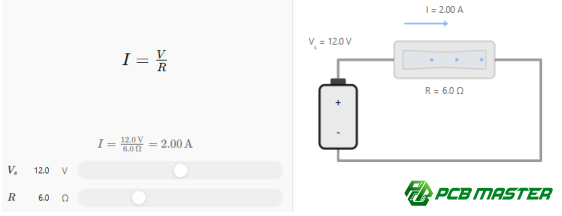
The required resistance is calculated by:
R = (Vs − Vf) / If
Where:
- R = resistance (Ω)
- Vs = supply voltage
- Vf = LED forward voltage
- If = LED forward current (A)
Example
Given:
- Supply voltage: 5 V
- Red LED forward voltage: 2.0 V
- Desired current: 20 mA (0.02 A)
Calculation:
R = (5 − 2) / 0.02 = 150 Ω
A 150 Ω resistor is the appropriate choice.
Typical LED Forward Voltages
| LED Color | Typical Forward Voltage |
|---|---|
| Red | 1.8–2.2 V |
| Yellow | 2.0–2.2 V |
| Green | 2.0–3.2 V |
| Blue | 3.0–3.5 V |
| White | 3.0–3.5 V |
| UV | 3.2–4.0 V |
Actual values vary depending on the LED manufacturer and operating conditions.
Choosing the Correct Resistor Wattage
Besides resistance, power rating is also important.
Power dissipated by the resistor is:
P = I² × R
Example:
- Current = 20 mA
- Resistance = 150 Ω
Power:
P = 0.02² × 150 = 0.06 W
A 1/4 W (0.25 W) resistor provides a comfortable safety margin.
For higher-current LED circuits or LED arrays, higher-wattage resistors may be required.
Common LED Resistor Values
| Supply Voltage | Typical LED | Common Resistor |
|---|---|---|
| 3.3 V | Red | 68–100 Ω |
| 5 V | Red | 150 Ω |
| 5 V | White | 100 Ω |
| 9 V | Red | 330–390 Ω |
| 12 V | White | 430–470 Ω |
| 24 V | White | 1 kΩ |
These values are typical starting points. Always verify using the LED's datasheet.
LED Resistor Selection for PCB Design
When designing PCBs, resistor selection involves more than calculating resistance.
Engineers should also consider:
Component Package
Choose packages suitable for assembly, such as:
- 0201
- 0402
- 0603
- 0805
- 1206
Smaller packages save space, while larger packages offer higher power handling.
Tolerance
Typical resistor tolerances include:
- ±1%
- ±5%
High-precision applications generally use ±1% resistors.
Thermal Management
High-current LEDs generate significant heat. PCB designers should consider:
- Copper area
- Thermal vias
- Proper component spacing
- Adequate airflow
Manufacturing Consistency
Maintaining consistent resistor values across production batches helps ensure uniform LED brightness in mass production.
Common Mistakes When Selecting LED Resistors
| Mistake | Potential Result | Recommended Practice |
|---|---|---|
| No resistor | Immediate LED failure | Always use current limiting |
| Wrong forward voltage | Incorrect current | Check the LED datasheet |
| Ignoring resistor power | Overheating | Select adequate wattage |
| Assuming all LEDs are identical | Brightness inconsistency | Verify LED specifications |
| Using the same resistor for different supply voltages | Poor performance | Recalculate for each circuit |
PCBMASTER's Approach to Reliable LED PCB Manufacturing
Selecting the correct LED resistor is only one part of building a reliable electronic product. PCB layout quality, manufacturing precision, and assembly consistency are equally important.
As a professional provider of PCB, PCBA, and SMT manufacturing services , PCBMASTER supports projects ranging from rapid prototypes to high-volume production. With ISO 9001 , IATF 16949 , UL Certification , and RoHS compliance , PCBMASTER delivers dependable manufacturing for consumer electronics, industrial controls, automotive electronics, communications, and many other applications.
Its engineering team also provides free DFM (Design for Manufacturability) review , helping customers identify potential issues before production, optimize component placement, and improve manufacturability while controlling overall project costs.
Future Trends in LED Circuit Design
As LED technology continues to evolve, resistor selection is becoming increasingly integrated with intelligent power management.
Key industry trends include:
- Constant-current LED driver ICs replacing discrete resistors in high-power applications
- More compact PCB layouts using miniature SMD resistors
- Higher-efficiency lighting systems with improved thermal design
- Smart lighting and IoT-enabled LED products
- Increased adoption of automotive-grade LED electronics requiring stringent quality standards
Although advanced LED drivers are becoming more common, simple current-limiting resistors remain the most economical and widely used solution for countless electronic products.
Conclusion
An LED resistor is a simple yet essential component that protects LEDs by limiting current, ensuring stable brightness, and improving overall circuit reliability. Correct resistor selection requires understanding supply voltage, LED forward voltage, operating current, and power dissipation.
For PCB projects moving from prototype to mass production, combining proper circuit design with high-quality PCB manufacturing and professional engineering support helps achieve reliable, long-lasting products. Companies such as PCBMASTER demonstrate how careful design review, advanced manufacturing capabilities, and rigorous quality management contribute to successful LED-based electronic systems.
Tags: #LEDResistor #LEDCircuit #PCBDesign #PCBA #SMT #Electronics #CurrentLimitingResistor #LEDLighting #PCBMASTER #DFM #ElectronicsManufacturing #EngineeringKnowledge
About the Author

Carol Luo
PCB Design EngineerI'm Carol, a PCB Engineer at PCBMASTER with experience in PCB design and manufacturing engineering since 2018. I focus on translating engineering requirements into reliable PCB solutions, with expertise in stack-up design, material selection, and design-for-manufacturing (DFM). I share practical engineering insights from real-world PCB design and production experience.
Visit Carol Luo's Profile