








1k Ohm Resistor Color Code: How to Read, Calculate, and Choose the Right Resistor
The 1k ohm resistor (1,000Ω) is one of the most used passive components in electronic circuits like PCB design, PCBA assembly, LED circuits, pull-up/pull-down networks, and voltage dividers. The colour code varies according to the tolerance of the resistor and the number of colour bands. The most common 4 band 1kΩ resistor is Brown-Black-Red-Gold and the 5 band version is Brown-Black-Black-Brown-Brown. Resistor colour codes allow engineers to rapidly identify resistance values during PCB assembly, troubleshooting, and quality inspection processes.
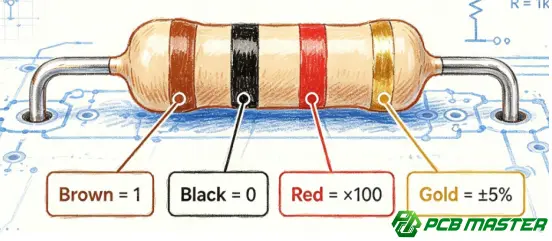
What Is the Color Code for a 1k Ohm Resistor?
The colour bands on a resistor indicate the resistance value, multiplier and tolerance.
4-Band 1k Ohm Resistor
| Band | Color | Meaning |
|---|---|---|
| 1 | Brown | 1 |
| 2 | Black | 0 |
| 3 | Red | ×100 |
| 4 | Gold | ±5% |
Color Code: Brown – Black – Red – Gold
Calculation:
- First two digits: 10
- Multiplier: ×100
- Resistance: 10 × 100 = 1,000 Ω (1 kΩ)
- Tolerance: ±5%
5-Band 1k Ohm Resistor Color Code
Five colour bands are usually for higher precision resistors.
| Band | Color | Meaning |
|---|---|---|
| 1 | Brown | 1 |
| 2 | Black | 0 |
| 3 | Black | 0 |
| 4 | Brown | ×10 |
| 5 | Brown | ±1% |
Color Code: Brown – Black – Black – Brown – Brown
Calculation:
- Significant digits: 100
- Multiplier: ×10
- Resistance: 100 × 10 = 1,000 Ω (1 kΩ)
- Tolerance: ±1%
4-Band vs. 5-Band 1kΩ Resistors
| Feature | 4-Band | 5-Band |
|---|---|---|
| Typical tolerance | ±5% | ±1% |
| Color code | Brown-Black-Red-Gold | Brown-Black-Black-Brown-Brown |
| Accuracy | Standard | High precision |
| Common applications | General electronics | Precision measurement, industrial control, automotive electronics |
How to Read a 1k Ohm Resistor
Follow these simple steps:
- Locate the tolerance band (usually Gold, Silver, Brown, or Red).
- Read the resistor from the opposite end.
- Identify the significant digits.
- Apply the multiplier.
- Check the tolerance.
For a resistor with Brown–Black–Red–Gold :
- Brown = 1
- Black = 0
- Red = ×100
- Gold = ±5%
Result: 1,000 Ω (1 kΩ) ±5%
Where Are 1kΩ Resistors Used?
1kΩ is a very standard resistor value used in electronic circuits and PCB designs . It is a good compromise between limiting current and conditioning the signal .
Common applications include:
- LED current limiting
- Pull-up and pull-down resistors
- Voltage divider circuits
- Microcontroller GPIO interfaces
- Transistor base resistors
- Signal conditioning
- Sensor interface circuits
- General-purpose analog and digital electronics
Why Is Knowing the Correct Color Code Important?
Correct resistor identification helps prevent:
- Incorrect component placement during SMT or through-hole assembly
- Circuit malfunction caused by using the wrong resistance
- Production defects during PCB assembly
- Longer debugging and repair times
- Higher manufacturing costs due to assembly errors
One fundamental yet vital quality control step in prototype and mass-production PCB projects is to verify resistor values prior to assembly.
PCB Assembly Considerations
And even in today's SMT manufacturing, with automated pick-and-place machines and barcode-based component management, colour codes still matter for:
- Through-hole PCB assembly
- Engineering prototypes
- Laboratory testing
- Manual repairs
- Educational electronics
- Incoming component inspection
PCB manufacturers check component values during engineering review and quality inspection to reduce assembly errors before production.
PCBMASTER offers free engineering file checks before manufacturing to help identify possible design and manufacturability problems. Together with automated inspection processes and overall quality management, this reduces the risk of selecting the wrong components and increases the reliability of production. Resistor verification is supported by stringent quality management systems certified to ISO 9001, IATF 16949, UL and RoHS standards in the PCB and PCBA manufacturing.
Common 1kΩ Resistor Color Codes
| Resistance | 4-Band Color Code | 5-Band Color Code |
|---|---|---|
| 1kΩ ±5% | Brown – Black – Red – Gold | — |
| 1kΩ ±1% | — | Brown – Black – Black – Brown – Brown |
| 1kΩ ±2% | — | Brown – Black – Black – Brown – Red |
Conclusion
A 1k ohm resistor has a resistance of 1,000Ω. A standard 4-band resistor has a colour code of Brown–Black–Red–Gold, while a precision 5-band resistor has a colour code of Brown–Black–Black–Brown–Brown. The Resistor Colour Code is a very important skill for electronics engineers, PCB designers, technicians and students. Getting the resistor values right is the key to reliable circuit operation and efficient manufacturing whether you’re prototyping, putting together a PCB, or troubleshooting a circuit.
Tags: #1kOhmResistor #ResistorColorCode #Electronics #PCB #PCBA #SMT #CircuitDesign #ElectronicComponents #PCBMASTER #ElectronicsEngineering
About the Author

Carol Luo
PCB Design EngineerI'm Carol, a PCB Engineer at PCBMASTER with experience in PCB design and manufacturing engineering since 2018. I focus on translating engineering requirements into reliable PCB solutions, with expertise in stack-up design, material selection, and design-for-manufacturing (DFM). I share practical engineering insights from real-world PCB design and production experience.
Visit Carol Luo's Profile