








Neutral Grounding Resistor (NGR): Purpose, Working Principle, Types, Selection, and Applications
A Neutral Grounding Resistor (NGR) is a protective resistor that is connected between the neutral point of a power transformer or generator and earth (ground). Its main function is to limit the ground fault current to a safe value so that the protective relays can detect and isolate the fault in a quick manner. Well chosen NGRs result in less damage to equipment, less arc flash energy, better system stability and operational continuity. They are widely used in industrial plants, power generation, mining, petrochemical plants, data centres and renewable energy systems. For equipment with high-voltage control electronics, protection relays and monitoring circuits, reliable PCB and PCBA manufacturing is also important for dependable grounding protection systems. PCBMASTER is a trusted manufacturing partner of OEMs providing high-reliability PCB and PCBA solutions for industrial power applications.
What Is a Neutral Grounding Resistor?
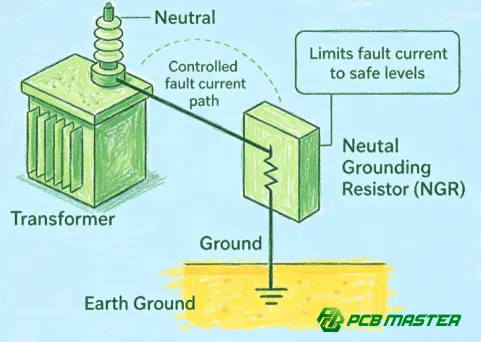
A neutral grounding resistor (NGR) is a resistor which is connected between the neutral point of a transformer or generator and ground (earth). For a single line to ground fault the resistor is used to limit the current flowing to earth intentionally rather than allowing an unlimited fault current.
Without proper neutral grounding, ground faults can cause the following:
- Excessive fault currents
- Severe equipment damage
- Dangerous arc flash incidents
- Voltage instability
- Longer system downtime
A NGR limits the fault current to a certain value and it is a compromise between the protection of the system and operational reliability.
Why Is a Neutral Grounding Resistor Important?
In today’s industrial electrical systems, effective grounding strategies are essential. There are several key advantages to use a neutral grounding resistor.
Limits Ground Fault Current
An NGR is primarily used to limit the fault current to a level at which protective devices can interrupt the current safely.
Benefits include:
- Reduced thermal stress
- Lower mechanical stress on equipment
- Improved breaker performance
- Reduced repair costs
Minimizes Arc Flash Energy
The enormous heat and pressure produced by high fault currents.
Reducing fault current helps:
- Improve worker safety
- Lower arc flash energy
- Protect electrical switchgear
- Reduce fire risks
Improves System Stability
The NGR offers system voltage support for transient faults and mitigates the overvoltage conditions that are characteristic of ungrounded systems.
This improves:
- Power quality
- Equipment lifespan
- Operational continuity
Enables Fast Fault Detection
Ground fault relays can detect limited fault currents accurately.
This enables:
- Faster isolation
- Easier troubleshooting
- Reduced production downtime
How Does a Neutral Grounding Resistor Work?
In normal situations, the NGR will have little or no current as the system is balanced.
When a single phase contacts ground:
- Fault current flows through the grounding resistor.
- The resistor limits the magnitude of the current.
- Protection relays detect the fault.
- Circuit breakers isolate the affected circuit.
- The remaining system remains protected.
This controlled current flow prevents catastrophic equipment damage, and provides reliable fault detection.
Types of Neutral Grounding Resistors
Neutral grounding resistors are typically classified according to the magnitude of fault current permitted.
| Type | Typical Fault Current | Primary Purpose | Typical Applications |
|---|---|---|---|
| High Resistance Grounding (HRG) | 1–10 A | Maintain operation during first ground fault | Data centers, continuous process industries |
| Low Resistance Grounding (LRG) | 50–400 A | Rapid fault detection and clearing | Industrial plants, mining, utilities |
| Distribution Grounding Resistors | Varies | Distribution network protection | Commercial and industrial power systems |
| Generator Neutral Grounding Resistors | Customized | Generator protection | Power generation facilities |
High Resistance Grounding vs Low Resistance Grounding
| Feature | High Resistance Grounding | Low Resistance Grounding |
|---|---|---|
| Fault Current | Very Low | Moderate |
| Equipment Damage | Minimal | Low |
| Production Continuity | Excellent | Moderate |
| Fault Detection | Specialized relays | Standard relays |
| Typical Use | Continuous operation systems | Heavy industrial facilities |
Whether you choose HRG or LRG depends on the safety requirements, system voltage, protection philosophy and operating priorities.
Key Selection Factors
Several technical parameters need to be evaluated in order to select the correct neutral grounding resistor.
System Voltage
The resistor has to be sized for the system line-to-neutral voltage.
Desired Fault Current
Engineers decide what fault current is allowable, based on:
- Protection relay sensitivity
- Equipment ratings
- Safety requirements
- Applicable standards
Time Rating
NGRs are typically rated for:
- 10 seconds
- 30 seconds
- 60 seconds
- Continuous duty
The expected time to clear a fault sets the rating.
Thermal Capacity
The resistor must be rated to safely absorb the energy developed during a fault condition without exceeding its temperature limits.
Environmental Conditions
The choice of material depends on the place of installation.
Common considerations include:
- Indoor vs outdoor installation
- Ambient temperature
- Humidity
- Corrosion resistance
- Enclosure protection (IP rating)
Typical Applications
Neutral grounding resistors are widely used in many industries.
Industrial Manufacturing
Protects:
- Large motors
- Variable frequency drives (VFDs)
- Automation equipment
- Process control systems
Power Generation
Generator neutral grounding protection includes the following:
- Turbine generators
- Diesel generators
- Gas generators
- Renewable energy systems
Mining Operations
Reliable grounding of mining equipment is required because:
- Long cable runs
- High-power motors
- Harsh operating environments
Petrochemical Plants
Continuous process industries benefit from reduced down time and personnel safety.
Data Centers
High resistance grounding enables operators to maintain critical loads while locating the first ground fault.
Common Design Considerations
In system design, engineers usually consider the following:
| Design Factor | Engineering Consideration |
|---|---|
| System Voltage | Match line-to-neutral voltage |
| Fault Current | Coordinate with protection relays |
| Resistance Value | Determine required current limitation |
| Duty Cycle | Match expected clearing time |
| Cooling | Natural or forced ventilation |
| Monitoring | Ground fault relay compatibility |
| Enclosure | Indoor or outdoor protection |
Common Mistakes to Avoid
A frequent source of many grounding problems is the use of the wrong resistor.
Avoid these common mistakes:
- Selecting the wrong resistance value
- Ignoring relay coordination
- Undersizing thermal capacity
- Using incorrect duty ratings
- Neglecting environmental protection requirements
- Omitting routine inspection and maintenance
Good engineering analysis is key to system reliability over long-term.
PCB and PCBA Considerations for Grounding Protection Equipment
The resistor is a passive component but modern neutral grounding systems often contain complex electronic assemblies such as:
- Ground fault monitoring boards
- Protection relay PCBs
- Current sensing circuits
- Communication modules
- Remote monitoring interfaces
- PLC control boards
These electronic modules rely on the quality of the PCB manufacturing to ensure reliable operation in electrically demanding environments.
PCBMASTER, an industrial electronics manufacturer, offers PCB, PCBA and SMT solutions for power protection equipment. PCBMASTER helps OEMs build dependable protection systems for industrial power, energy, automation and electrical infrastructure with certifications such as IATF 16949, ISO 9001, UL and RoHS, an 80,000㎡ manufacturing facility, cutting-edge AOI inspection, free DFM review, quick prototyping and a 99.59% on-time delivery rate.
Future Trends in Neutral Grounding Systems
The neutral grounding technology develops together with the smart power systems.
Key trends include:
- Intelligent digital monitoring
- IoT-enabled fault diagnostics
- Predictive maintenance
- Integration with Industry 4.0 platforms
- Remote condition monitoring
- Higher reliability for renewable energy and microgrids
Such improvements increase safety, lower the cost of maintenance and improve resilience of the power system.
Conclusion
Neutral grounding resistors play a very important role in protecting electrical power systems from the adverse effects of ground faults. NGRs are used in a variety of industrial applications to help ensure safe and reliable operation by limiting fault current, reducing arc flash energy, improving fault detection and improving overall system stability.
As grounding systems get smarter, the reliability of the electronic monitoring and control hardware is as important as the resistor itself. There is therefore a constant demand for quality PCB and PCBA manufacturing, so that power protection solutions can be trusted to deliver long-term performance even in harsh industrial environments.
Tags: #NeutralGroundingResistor #NGR #ElectricalProtection #GroundFaultProtection #PowerDistribution #IndustrialAutomation #PCB #PCBA #SMT #PCBMASTER #ElectricalEngineering #PowerSystems #IndustryInsights
About the Author

Carol Luo
PCB Design EngineerI'm Carol, a PCB Engineer at PCBMASTER with experience in PCB design and manufacturing engineering since 2018. I focus on translating engineering requirements into reliable PCB solutions, with expertise in stack-up design, material selection, and design-for-manufacturing (DFM). I share practical engineering insights from real-world PCB design and production experience.
Visit Carol Luo's Profile