








Do You Need a Resistor for a Piezo Tweeter? How to Choose the Right Resistor Value
Adding a resistor to a piezo tweeter is common, but it's not always necessary, depending on your speaker design and performance goals. Piezo tweeters are not capacitive loads as conventional dynamic tweeters are and generally do not require a crossover capacitor. A well-chosen resistor can help with amplifier compatibility, control harsh highs, stabilise impedance and produce a more balanced sound. Knowing when and how to use a resistor with a piezo tweeter can help you get the best audio performance, while also protecting the equipment it’s connected to. Selecting the right resistor configuration is an important step for designers and manufacturers in building reliable loudspeaker systems.
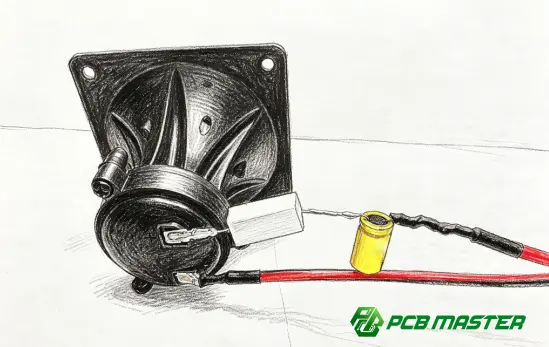
Why Piezo Tweeters Are Different from Conventional Tweeters
A piezo tweeter uses a piezoelectric ceramic material instead of a conventional voice coil. When you apply voltage, the ceramic quickly changes its shape and generates high-frequency sound waves.
Due to this operating principle, piezo tweeters behave differently than dynamic tweeters:
- They present a capacitive impedance rather than a resistive load.
- Current consumption is extremely low.
- No external crossover capacitor is usually required.
- Impedance changes significantly with frequency.
It is these qualities that lead to the choice of resistors being often a matter of discussion when piezo tweeters are added to speaker systems.
Do You Need a Resistor on a Piezo Tweeter?
The quick answer is:
Not usually, but yes in many practical circumstances.
You may or may not need a resistor depending on the amplifier, the crossover network and the sound quality you want.
| Application | Recommended? | Reason |
|---|---|---|
| Direct connection to amplifier | Usually Yes | Improves amplifier load stability |
| Passive crossover systems | Yes | Makes crossover calculations more predictable |
| Simple DIY speaker projects | Recommended | Reduces excessive brightness |
| Active crossover systems | Sometimes | Depends on crossover design |
| Standalone piezo buzzer circuits | Usually No | Different operating requirements |
Why Add a Resistor to a Piezo Tweeter?
Resistors have some advantages in loudspeaker designs.
1. Stabilizes Amplifier Load
Some amps will become unstable when directly driving piezo tweeters because they act like capacitors.
A resistor makes the load more predictable and helps to keep the amplifier stable.
2. Reduces Harsh High Frequencies
Piezo tweeters are often noted for the very bright quality of their treble.
A little of the output is attenuated by a resistor, so that we have:
- smoother response
- reduced listening fatigue
- more natural sound balance
3. Improves Passive Crossover Performance
Passive crossovers are normally designed for resistive speaker loads.
The crossover network is aided by a resistor to function more in accordance with the design parameters.
4. Protects Some Amplifier Designs
Piezo tweeters are capacitive in nature. They draw very little current but the capacitive nature can cause problems for certain amplifier circuits.
It helps to cut down on the effect of a resistor.
Common Resistor Values for Piezo Tweeters
The proper resistor will depend on the speaker system and how much you want to attenuate.
| Resistor Value | Typical Purpose |
|---|---|
| 10 Ω | Mild damping |
| 22 Ω | Common general-purpose choice |
| 33 Ω | Improved amplifier stability |
| 47 Ω | Moderate attenuation |
| 100 Ω | Significant output reduction |
Many commercial speaker systems use resistors in the range of 22 Ω to 33 Ω . It is a practical compromise between efficiency and tone balance .
Series vs. Parallel Resistor Configurations
There are two typical ways to wire this.
Series Resistor
Amplifier (+)
|
Resistor
|
Piezo Tweeter
|
Amplifier (-)
Advantages:
- reduces output level
- smooths treble
- easy to install
Parallel (Shunt) Resistor
Amplifier (+)
|
Piezo Tweeter
|
+---- Resistor ------+
| |
Amplifier (-)--------------+
Advantages:
- presents a more resistive load
- improves crossover behavior
- commonly used in commercial loudspeakers
Combined Series and Parallel Network
Some professional speaker systems use both:
- series resistor for attenuation
- parallel resistor for impedance stabilization
This setup often provides the most consistent performance.
Choosing the Correct Resistor Power Rating
Piezo tweeters don’t draw much current, but don’t forget about resistor power.
General recommendations are:
| Speaker Power | Suggested Resistor Rating |
|---|---|
| Under 50 W | 2 W |
| 50–150 W | 5 W |
| Above 150 W | 10 W or higher |
Wirewound resistors are commonly selected because they offer:
- excellent heat dissipation
- long-term reliability
- stable resistance values
Common Mistakes to Avoid
Using Too Small a Resistor
Very low resistance provides little benefit and may unnecessarily increase power dissipation.
Using Excessively High Resistance
High resistance values may cause the tweeter output to be too low, which can result in a dull sounding system.
Ignoring Amplifier Compatibility
Some amplifiers can handle capacitive loads better than others. Always check amplifier specifications before connecting the piezo drivers directly.
Using Underrated Resistors
A resistor that is too small can get hot at high power for long periods of time.
Always select adequate wattage for continuous use.
Selecting High-Quality Resistors for Speaker Applications
The resistor is a small item, but the quality has a direct effect on reliability and consistency.
When choosing resistors for loudspeaker assemblies consider:
- tight resistance tolerance
- adequate power rating
- low temperature coefficient
- excellent solderability
- proven long-term stability
- compliance with RoHS requirements
For OEM speaker manufacture, consistent resistor quality is conducive to uniform acoustic performance over production batches.
PCBMASTER's Experience in Audio Electronics Manufacturing
PCBMASTER is a professional manufacturer for PCB, PCBA and SMT technology used industries, and provides reliable electronic manufacturing solutions for audio equipment manufacturers.
PCBMASTER provides high quality PCB fabrication and PCB assembly for a wide range of applications from consumer audio products to industrial electronics with ISO 9001, IATF 16949, UL Certificate and RoHS certification.
Key advantages include:
- 24-hour PCB prototyping
- Free engineering document review
- Advanced AOI inspection and three-stage quality control
- 99.5% product yield
- 99.59% on-time delivery
- One-stop PCB manufacturing, component sourcing, and SMT assembly from an 80,000㎡ factory
PCBMASTER helps audio device manufacturers integrating piezo tweeters and crossover circuits achieve stable production quality, rapid turnaround and dependable manufacturing support from prototype to volume production.
Future Trends in Piezo Tweeter Circuit Design
As audio equipment advances, designers are increasingly worried about:
- optimized impedance matching
- improved crossover simulation
- compact SMT resistor integration
- enhanced reliability for portable devices
- lower manufacturing costs without sacrificing performance
The right resistor is still a simple but effective way to improve piezo tweeter performance, and it also ensures compatibility with the amplifier and long term system reliability.
Conclusion
Running a resistor on a piezo tweeter is not always necessary, but often very helpful. Correctly chosen resistors can stabilise the loading of the amplifier, improve the crossover performance, reduce excessive brightness and improve the overall sound quality. Most speaker designs work well with resistors in the 22-33 Ω range, although the ideal value depends on the particular application and the desired acoustic characteristics.
Manufacturers who want to make reliable loudspeaker products can guarantee that their products perform the same from prototype to mass production by pairing good electrical design with high quality PCB and PCBA manufacturing. Certified PCBMASTER manufacturing and one-stop electronics solutions help us assist customers in building reliable audio products that are compliant with stringent global quality standards.
Tags: #PiezoTweeter #Resistor #SpeakerDesign #AudioElectronics #PCB #PCBA #SMT #PCBMASTER #CrossoverDesign #ElectronicsManufacturing #IndustryInsights
About the Author

Carol Luo
PCB Design EngineerI'm Carol, a PCB Engineer at PCBMASTER with experience in PCB design and manufacturing engineering since 2018. I focus on translating engineering requirements into reliable PCB solutions, with expertise in stack-up design, material selection, and design-for-manufacturing (DFM). I share practical engineering insights from real-world PCB design and production experience.
Visit Carol Luo's Profile