








10k Resistor Color Code: How to Read Color Bands, Identify a 10KΩ Resistor, and Verify Its Value
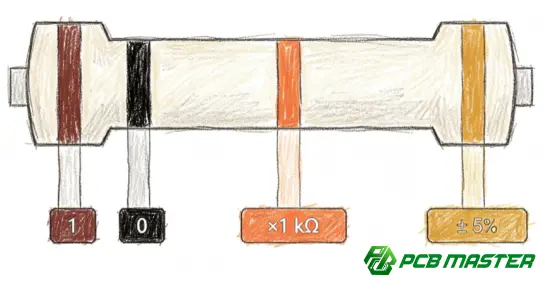
A 10k resistor is a resistor with a nominal resistance of 10,000 ohms , (10 kΩ) . It is one of the most common components found in electronic circuits. The easiest way to identify a 10KΩ resistor is via its color bands. A 10k resistor in a standard 4 band resistor would be Brown-Black-Orange-Gold (±5% tolerance). The color bands are slightly different for 5 and 6 band resistors to increase accuracy. Knowing resistor color codes allow engineers , technicians and hobbyists to quickly identify resistor values , reduce errors during assembly and check the resistor before installation .
What Is a 10k Resistor?
A 10k resistor is a resistor with a resistance value of 10,000 ohms. It is often written as:
- 10,000 Ω
- 10 kΩ
- 10K resistor
The “k” stands for kilo, which means 1,000.
So, thus:
10 × 1,000 = 10,000 Ω
Typical Uses of 10K Resistors are:
- Pull-up and pull-down resistors
- LED current limiting (depending on supply voltage)
- Voltage dividers
- Signal conditioning
- Sensor circuits
- Timing circuits
- Microcontroller input protection
- Analog reference circuits
They are versatile and useful in practically every PCB design from consumer electronics to automotive control modules to industrial equipment.
How Does the Resistor Color Code Work?
Resistor color bands provide an easy visual way of identifying resistance values without the need to measure them.
For most through-hole resistors:
- The first bands represent significant digits.
- The next band is the multiplier.
- The last band indicates tolerance.
- Some precision resistors include an additional temperature coefficient band.
Standard Color Code Table
| Color | Digit | Multiplier | Tolerance |
|---|---|---|---|
| Black | 0 | ×1 | — |
| Brown | 1 | ×10 | ±1% |
| Red | 2 | ×100 | ±2% |
| Orange | 3 | ×1,000 | — |
| Yellow | 4 | ×10,000 | — |
| Green | 5 | ×100,000 | ±0.5% |
| Blue | 6 | ×1,000,000 | ±0.25% |
| Violet | 7 | ×10,000,000 | ±0.1% |
| Gray | 8 | ×100,000,000 | ±0.05% |
| White | 9 | ×1,000,000,000 | — |
| Gold | — | ×0.1 | ±5% |
| Silver | — | ×0.01 | ±10% |
10k Resistor Color Code (4-Band)
The most common 10K resistor has 4-band of color.
| Band | Color | Meaning |
|---|---|---|
| 1 | Brown | 1 |
| 2 | Black | 0 |
| 3 | Orange | ×1,000 |
| 4 | Gold | ±5% |
Calculation:
10 × 1,000 = 10,000 Ω
Therefore:
Brown – Black – Orange – Gold = 10kΩ ±5%
The most common resistor found in educational kits, consumer electronic devices and general purpose circuits.
10k Resistor Color Code (5-Band)
Usually 5-band are used on precision resistors.
| Band | Color | Meaning |
|---|---|---|
| 1 | Brown | 1 |
| 2 | Black | 0 |
| 3 | Black | 0 |
| 4 | Red | ×100 |
| 5 | Brown | ±1% |
Calculation:
100 × 100 = 10,000 Ω
Result:
Brown – Black – Black – Red – Brown = 10kΩ ±1%
5 band resistors have tighter manufacturing tolerances and better measurement accuracy then 4 band resistors.
10k Resistor Color Code (6-Band)
- band resistors add a temperature coefficient (TCR) band.
Example:
| Band | Color | Meaning |
|---|---|---|
| 1 | Brown | 1 |
| 2 | Black | 0 |
| 3 | Black | 0 |
| 4 | Red | ×100 |
| 5 | Brown | ±1% |
| 6 | Brown | 100 ppm/°C |
This one still says 10kΩ. The sixth band tells us how the resistance varies with temperature.
Typical applications for 6-band resistors include:
- Medical electronics
- Precision instrumentation
- Industrial automation
- Automotive electronics
- Measurement equipment
How to Read a 10k Resistor Correctly
Once you know where to start, resistor color bands are easy to read.
Step 1: Find the Tolerance Band
The tolerance band is usually:
- Gold
- Silver
- Brown (precision resistors)
It's a little further from the other bands.
Step 2: Read From the Opposite End
Begin reading from the end away from the tolerance band.
Step 3: Convert Colors to Numbers
Example:
Brown = 1
Black = 0
Orange = ×1000
Gold = ±5%
Result:
10 × 1000 = 10,000Ω
How to Verify a 10k Resistor with a Multimeter
The color bands indicate the nominal value but the resistor is checked by measuring it .
Procedure
- Set the multimeter to resistance (Ω).
- Choose the 20kΩ or auto-ranging mode.
- Place one probe on each resistor lead.
- Read the displayed resistance.
Typical readings include:
- 9.95 kΩ
- 10.02 kΩ
- 9.87 kΩ
All these values may be acceptable depending on the tolerance of the resistor.
Understanding Tolerance
The tolerance of a resistor is the range of possible values of the resistance from the nominal.
For a 10kΩ ±5% resistor :
Minimum:
10,000 − 500 = 9,500Ω
Maximum:
10,000 + 500 = 10,500Ω
For a 10kΩ ±1% resistor :
Minimum:
9,900Ω
Maximum:
10,100Ω
For precision analog, sensing, and instrumentation circuits, lower tolerances are usually desired.
Why 10kΩ Is Such a Popular Resistance Value
Design engineers often pick 10K resistors as a practical compromise between current consumption, noise immunity and digital logic compatibility.
Common applications include:
- Microcontroller pull-up resistors
- Reset circuits
- MOSFET gate biasing
- Voltage divider networks
- Temperature sensing circuits
- Comparator reference circuits
- Transistor bias networks
- RC timing circuits
This versatility leads to 10K resistors being a common component in almost any electronics lab and PCB assembly line.
Common Mistakes When Identifying a 10k Resistor
Reading the Bands Backward
First read the tolerance band and then read the other bands.
Confusing Orange and Red
The multiplier is very sensitive to a little change in color.
For example:
- Brown-Black-Red = 1kΩ
- Brown-Black-Orange = 10kΩ
Assuming Every Brown-Black Resistor Is 10kΩ
The multiplier band gives the last resistance value. Never use the first 2 bands to identify a resistor.
Ignoring Tolerance
In precision circuits a ±1% resistor may be required where a ±5% resistor would not be suitable for the purpose.
10k Resistor Color Code Comparison
| Resistor Type | Color Bands | Resistance | Tolerance |
|---|---|---|---|
| 4-Band | Brown-Black-Orange-Gold | 10kΩ | ±5% |
| 4-Band | Brown-Black-Orange-Silver | 10kΩ | ±10% |
| 5-Band | Brown-Black-Black-Red-Brown | 10kΩ | ±1% |
| 6-Band | Brown-Black-Black-Red-Brown-Brown | 10kΩ | ±1%, 100 ppm/°C |
Choosing the Right 10k Resistor for Your PCB
Choosing a resistor is not just a question of matching resistance. Engineers also have to think about:
- Power rating (e.g., 1/8W, 1/4W, 1/2W)
- Tolerance requirements
- Temperature coefficient
- Through-hole vs. surface-mount package
- Operating environment
- Long-term reliability
In high volume manufacturing, the choice of components is critical to achieving consistent assembly, reducing field failures and providing stable circuit performance.
PCBMASTER engineering teams review customer BOMs and manufacturing files before production to ensure component compatibility with PCB layouts and assembly processes. ISO 9001, IATF 16949, UL and RoHS certified manufacturing, comprehensive quality inspection and single-source PCB and PCBA services, combined with engineering review, reduce production risks and enable reliable, repeatable electronic products.
Frequently Asked Questions
What is the color code for a 10k resistor?
The most common 4-band 10k resistor color code is:
Brown – Black – Orange – Gold
This represents 10kΩ ±5% .
What does Brown-Black-Orange mean?
Brown = 1
Black = 0
Orange = ×1000
Therefore:
10 × 1000 = 10,000Ω (10kΩ)
Is Brown-Black-Red a 10k resistor?
No.
Brown-Black-Red represents:
10 × 100 = 1,000Ω (1kΩ)
Can I use a multimeter instead of reading color bands?
Yeah. The best way to check the true resistance value of a resistor and confirm that it is within the specified tolerance is to use a digital multimeter.
Conclusion
When you learn how resistor color bands tell you digits, multipliers and tolerances, the 10k resistor color code is simple. The standard Brown-Black-Orange-Gold combination identifies a 10kΩ ±5% resistor, but the 5-band and 6-band versions provide more precision for demanding applications.
Identifying resistor values correctly is a basic electronics skill, whether you’re troubleshooting a circuit, creating a prototype or prepping a PCB for production. The color code identification combined with multimeter verification ensures reliable circuit function and minimizes errors. When a project moves from prototype to mass production, working with an experienced PCB and PCBA manufacturer such as PCBMASTER can help improve manufacturability and ensure quality consistency, and improve long-term product reliability.
About the Author

Carol Luo
PCB Design EngineerI'm Carol, a PCB Engineer at PCBMASTER with experience in PCB design and manufacturing engineering since 2018. I focus on translating engineering requirements into reliable PCB solutions, with expertise in stack-up design, material selection, and design-for-manufacturing (DFM). I share practical engineering insights from real-world PCB design and production experience.
Visit Carol Luo's Profile