








Force Sensing Resistor: Working Principle, Types, Applications, and Design Considerations
Many electronic devices these days have inputs that can sense pressure, so they can intelligently respond to different levels of force on them, not just touch. One of the technologies that enable this is the force sensing resistor (FSR) due to its thin profile, flexibility and low cost design. FSRs are a practical solution for sensing and measuring pressure in consumer electronics, wearable devices, robotics or industrial controls where space is at a premium.
But choosing the right force sensing resistor is more than knowing how it works. The operating principle, types, performance characteristics and design considerations determine the effectiveness of the device in practical applications. In the following sections we will go through how force sensing resistors work, the different types, common uses and key points to consider when using them in your electronics projects.
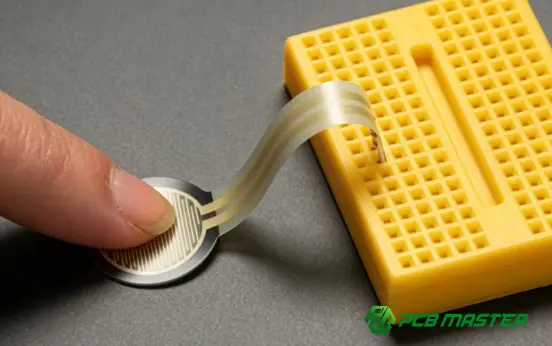
What Is a Force Sensing Resistor?
A force sensing resistor (FSR) is a thin flexible sensor which changes its electrical resistance dependent on the pressure or force applied to it. This is not like a normal resistor where the resistance value is fixed. An FSR will give you a variable resistance that drops with the increase of force. The simplicity of the design, the low cost and the small size make it a popular choice for applications where relative force or touch detection is more important than very precise force measurements.
Definition of a force sensing resistor
A force sensing resistor is an electronic sensor that measures the force applied to it by changing its resistance.
An FSR is a kind of variable resistor that reacts to physical pressure. It is very high at no force. As the force gets larger the resistance will be smaller and more current can flow through the circuit. This change can be measured by a micro-controller or other electronic means and translated into a force related signal.
A force sensing resistor is not designed for as accurate weight measurement as a load cell, but to detect the presence of force and to estimate the force magnitude. For example , a smart button could distinguish a gentle tap from a hard press through an FSR , or a robotic gripper could modulate its grasp based on the force detected by the sensor .
Main points :
- Detects pressure or applied force
- Resistance decreases as force increases
- Provides relative rather than highly precise force measurements
- Commonly used in touch and pressure sensing applications
Basic structure and materials
A force sensing resistor (FSR) is a sensor composed of two flexible layers that form a variable resistance when pressed together.
The majority of FSRs are thin polyester films. One layer has electrodes that carry electricity and the other layer has a pressure-sensitive resistive material on it, usually made from conductive polymer ink. Until a force is applied, the two layers are separated by a spacer.
By pressing the sensing area, the layers are brought into better electrical contact with each other. The larger the area of contact, the lower the resistance of the sensor. The change of resistance is measured by an electronic circuit and converted into a readable signal.
Their simple design means FSRs can be light and flexible, and are easily integrated into compact products. FSRs are used in wearable fitness gadgets, electronic musical instruments and interactive control panels where they help to fit into slim spaces that regular force sensors can’t.
Main parts are:
- Flexible polyester substrate
- Conductive electrode layer
- Pressure-sensitive resistive layer
- Spacer that separates the layers
- Electrical terminals for circuit connection
Key characteristics of an FSR
Force sensing resistors are popular because they are quick to respond, flexible and can be easily incorporated into electronic designs.
The FSR is not designed to be lab grade accurate but rather to reliably sense force in consumer electronic products. It is very sensitive to pressure and it returns to its original shape when the pressure is removed. The slim profile means it fits well in space-constrained devices.
However, FSRs are non-linear devices, i.e. resistance does not decrease linearly with an increase in force. Also, readings can be affected by such influences as temperature, repeated loading, and distribution of force on the sensing surface. That's why they are best suited to sense touch, pressure levels or user interaction but not to take precision measurements.
The main features are:
- Thin and flexible construction
- Lightweight and easy to install
- Fast response to applied force
- Low power consumption
- Wide sensing range for relative force detection
- Non-linear output that often requires calibration
- Cost-effective for high-volume electronic products
How Does a Force Sensing Resistor Work?
An FSR or force sensing resistor changes electrical resistance when a force is applied to its sensing surface. When a user presses on the sensor, the conductive particles inside are pushed closer together, creating a low-resistance path for electrical current to flow. The variation of this resistance is sensed by an electronic circuit and translated in a signal related to the force.
The working principle of an FSR
The working principle of an FSR is based on the change of resistance which is dependent on pressure
A force sensing resistor is a pressure sensitive material sandwiched between two conductive layers. In the absence of any force the contact between these layers is limited and hence resistance is high. They get pressed together and make more conductive paths. They transmit electricity more efficiently."
The electronic system does not directly measure the force. Rather it measures the change of resistance and utilises the relation between resistance and pressure to estimate the level of force.
For example, if an FSR is placed under a button, a light press causes a small change in resistance, and a heavy press causes a larger change. The microcontroller reads these changes. It can respond with various outputs, such as altering volume or speed of movement.
Working process is simple:
- Force is applied to the FSR surface.
- The pressure-sensitive material changes its electrical properties.
- The sensor resistance decreases.
- The circuit measures the resistance change.
- The system converts the signal into a force response.
How force changes electrical resistance
When a force is applied to an FSR, its electrical resistance decreases, improving the contact between conductive materials.
The force sensing resistor has a resistive layer with conductive particles in it. They part without squeezing. Giving electricity fewer ways to go. This creates a great resistance.
A force is exerted that compresses the sensing layer. The more conductive particles make contact with one another, the more current paths are created. This causes the value of resistance to fall.
This behaviour makes it possible for an FSR sensor to detect different levels of pressure. For example, the FSR-based touchscreen accessory can sense if the user is applying light touch or hard press because each level of pressure has its own resistance output.
Resistance and force :
- No pressure → High resistance
- Light pressure → Lower resistance
- Higher pressure → Much lower resistance
Force-resistance relationship
The relation between the force and the resistance of an FSR reveals that the resistance reduces with the rise of applied force but not linearly.
Most force sensing resistors (FSR) exhibit a large change in resistance for a small increase in force at low pressure levels. But the reduction in resistance is lower with the increase in applied force. This means that the sensor does not have the same resistance change for each force increment.
Due to this non-linear behaviour, FSRs are generally used for relatively measuring force rather than precisely measuring force. These are great for applications that need to know if the pressure is light, medium, or heavy.
For example you could use an FSR in a robotic hand to tell if it is holding an object gently or putting too much pressure on it. But a load cell would be used in general in a precision weighing system because it requires more precise force measurement.
Typical FSR output characteristics:
- Low force range → Large resistance changes
- Medium force range → Moderate resistance changes
- High force range → Smaller resistance changes
Factors affecting sensing performance
The performance of force sensing resistors can be affected by mechanical, environmental and electrical parameters.
Despite their simplicity and reliability, the output accuracy and repeatability of FSRs may be affected by several conditions.
1. Applied force distribution
Magnitude and direction of the exerted force. Generally, a force distributed evenly over the sensing area yields more consistent readings than a force concentrated at a point.
2. Temperature and Humidity
Environmental factors may influence the electrical properties of the sensing materials. Very high temperature or humidity can influence resistance values and long term stability.
3. Hysteresis
Slightly different resistances are obtained from FSRs whether the force is applied or released. This difference is called hysteresis and needs to be considered in the calibration.
4. Mechanical installation
How an FSR is mounted can affect its performance. To obtain stable readings, correct alignment, surface protection and even pressure distribution are required.
5. Sensor ageing and repeated use
The sensing material can evolve slowly over many pressure cycles. If an application requires long term reliability calibration, or periodic performance checks may be required.
Key considerations for improving FSR performance:
- Apply force evenly across the sensing area
- Use proper mechanical support
- Calibrate the sensor for the specific application
- Protect the sensor from harsh environments
- Select an FSR model suitable for the required force range
What Types of Force Sensing Resistors Are Available?
Force sensing resistors (FSRs) are available in different shapes and sizes like round, square, rectangular, strip and custom. The major difference between these types is the sensing area and physical shape that determine how well the sensor will fit into a particular application. The type of FSR is determined by the installation space, the location of the force and the sensing coverage required.
Round force sensing resistors
The most common type of FSR is the round force sensing resistor and is used extensively to measure pressure at a certain point.
The active area of these sensors is usually round and they are suitable for applications where the force is applied to a single point. Shape is round and sensing area is balanced suitable for button, touch control and human-machine interface.
For example, a small round FSR behind a control button of a portable electronic device can be used to detect different pressing strengths. Round FSRs are often selected for prototyping and consumer electronics due to their simple structure and ease of installation.
Common applications:
- Electronic buttons
- Touch-sensitive controls
- User input devices
- Small wearable products
Key advantages:
- Compact size
- Easy integration
- Good for point-force detection
- Available in many sensing diameters
Square and rectangular force sensing resistors
Square and rectangular force sensing resistors are made for applications where a larger or broader sensing area is required.
These sensors provide more surface coverage than round FSRs and can sense pressure over a larger area. Their flat shape makes them easier to install on panels, touch surfaces and mechanical structures.
For example, a pressure-sensitive control panel may use a rectangular FSR to detect where and how hard a user is pressing. These sensors are also useful if the position of the applied force can vary during operation.
Common uses:
- Touch panels
- Pressure detection surfaces
- Medical equipment interfaces
- Industrial control systems
Main advantages:
- Larger sensing area
- Better coverage for distributed pressure
- Suitable for flat mounting surfaces
- Flexible placement options
Strip and linear force sensing resistors
Strip and linear force sensing resistors are long, narrow FSR sensors that can be used to sense force along a given direction or area .
Unlike point-based FSR sensors, linear FSRs can be applied to cover extended areas where the pressure can be applied at different locations. They are useful when designers want to detect sliding pressure, position changes or multiple contact points.
A musical instrument interface, for instance, could be designed with a strip FSR to measure finger position and pressure along a continuous surface. Similarly a robotic system might employ a linear sensor to monitor the contact pressure over a gripping area.
Applications such as:
- Position-sensitive controls
- Touch sliders
- Robotics
- Pressure mapping systems
Main advantages:
- Detects force over a long area
- Suitable for continuous input
- Flexible installation design
- Supports multi-point pressure detection
Custom force sensing resistors
Custom Force Sensing Resistors Custom FSRs are special solutions with unique shapes, sizes or electrical configurations for specific applications.
Standard FSR products may not always suit complex product design requirements. Manufacturers can customise FSRs to change the sensor’s shape, sensing area, connector position, and mechanical structure to suit application requirements.
For instance, a wearable device might need a thin sensor that conforms to a curved surface, and an industrial tool might need a sensor with a special shape to fit the contact area.
Custom design options can include:
- Non-standard shapes
- Customized sensing areas
- Different thickness requirements
- Special connection layouts
Common uses:
- Wearable electronics
- Medical sensors
- Advanced human-machine interfaces
- Specialized industrial equipment
How to choose the right FSR type
The sensing area, installation space, force distribution and performance requirements of the application determine which type of force sensing resistor to use.
Before selecting an FSR, designers must determine where the force will be applied, the size of the sensing area, and if the sensor will detect a single point or a larger pressure area.
| Selection Factor | Round FSR | Square/Rectangular FSR | Strip/Linear FSR | Custom FSR |
|---|---|---|---|---|
| Best for | Single-point force detection | Large-area pressure sensing | Force detection along a line | Special applications |
| Sensing area | Small to medium | Medium to large | Long and narrow | Fully customizable |
| Installation | Easy | Easy on flat surfaces | Requires suitable space | Depends on design |
| Common uses | Buttons, switches, touch controls | Panels, interfaces, pressure surfaces | Sliders, robotics, position sensing | Wearables, medical, industrial |
| Main advantage | Simple and compact | Wider pressure coverage | Continuous force detection | Application-specific design |
Selection steps:
1. Define the sensing location
Decide if the force is going to be applied at a point, or over a larger area.
2. Measure available installation space
Choose a sensor shape compatible with the mechanical structure.
3. Identify the force detection requirement
Select a standard FSR for basic pressure sensing or a custom design for specialised applications.
4. Consider the operating environment
The choice should also be affected by the temperature, the mechanical stress and the demands for durability.
Matching the FSR type to application requirements provides the designers with improved sensing performance and reliable operation.
Where Are Force Sensing Resistors Used?
Force sensing resistors (FSRs) are used where simple, thin and low cost force or pressure sensing is required. They are widely used in consumer electronics, medical devices, robotics, wearable products and industrial systems where the detection of changes of applied force is more important than the measurement of force at laboratory level accuracy.
FSR sensors are flexible, light-weight and easy to integrate and are especially useful for products that require compact pressure sensing solutions.
Consumer electronics
Force sensing resistors are used in a wide variety of consumer electronic devices to detect touch, pressing force and user interaction.
For many electronic products, a simple on/off switch is insufficient. With the FSR devices can detect different degrees of pressure and therefore more flexible control functions.
For example, an FSR can be used in an electronic control panel to sense whether a user is lightly touching or firmly pressing the panel. If the pressure is greater the response may be different . It may increase the volume more quickly or alter the sensitivity of the control .
Some common applications in consumer electronics:
- Touch-sensitive buttons
- Gaming controllers
- Electronic keyboards
- Smart home control panels
- Portable electronic devices
Why FSRs are great for consumer electronics:
- Thin structure fits inside compact products
- Low cost supports mass production
- Low power consumption extends battery life
- Flexible design allows easy integration
Medical devices
Force sensing resistors are used in medical devices for pressure monitoring, contact force detection and improved user interaction.
Medical devices often require sensors to be light and flexible enough to fit in small spaces. FSRs can give pressure feedback without adding much size or weight to the device.
One example is a rehabilitation device where an FSR is used to measure the force a patient applies during an exercise. Also, a medical cushion or support system can be designed with multiple FSR sensors to detect the pressure distribution and help avoid excessive pressure on certain areas.
Common medical uses include:
- Rehabilitation equipment
- Pressure monitoring systems
- Prosthetic devices
- Patient support surfaces
- Medical training tools
Advantages in medical applications:
- Flexible placement
- Simple signal processing
- Comfortable for wearable medical products
- Suitable for pressure distribution detection
Robotics and automation
Force sensing resistors allow robots to sense contact forces and interact more safely with objects and people.
Robotic systems often require feedback to know how much pressure is being applied. FSR sensors can be used to easily detect contact and estimate grip force.
For example, if a robotic gripper is equipped with FSR sensors, it can tell if it is gripping a fragile object such as a plastic part or applying excess force that could damage it.
Typical applications of robotics are:
- Robotic grippers
- Human-robot interaction systems
- Tactile sensing systems
- Prototype robotic hands
Benefits for robotics:
- Small size for limited installation spaces
- Flexible shape for curved surfaces
- Fast response to contact changes
- Simple connection with control systems
Wearable technology
Wearable devices use force sensing resistors to measure body movement, pressure and user interaction.
Wearable product sensors must be thin, light weight, and comfortable FSRs can be integrated into clothing, gloves or flexible devices without significantly limiting user movement.
For instance, a smart glove can detect finger pressure and hand movement through multiple FSR sensors. This information can be used for virtual reality control, rehabilitation or gesture recognition.
Wearable applications are used in:
- Smart gloves
- Fitness devices
- Motion tracking systems
- Interactive clothing
- Flexible electronic devices
Why FSRs are good for wearable:
- Flexible construction
- Lightweight design
- Easy integration into fabric or flexible materials
- Suitable for repeated human interaction
Industrial equipment
Pressure sensing resistors are utilised in industrial equipment for pressure detection, machine control and operator interaction.
In industrial applications, FSRs are often used when the system needs to detect if force is applied rather than measure exact force values. Their simple design makes them useful for monitoring contact conditions and improving the operation of the machine.
For example an industrial control handle may have an FSR to determine the grip strength of an operator. FSR sensors can also be used in manufacturing equipment to confirm that a component is in place.
Common industrial applications are:
- Machine control interfaces
- Assembly equipment
- Contact detection systems
- Tool monitoring systems
Benefits to the industry:
- Easy installation
- Low maintenance requirements
- Compact size
- Reliable force detection for control systems
Typical application examples
Force sensing resistors are widely used in real-world products for pressure sensing and user feedback.
Examples of the working of FSR sensors in practical application are as follows:
| Application Example | How the FSR Is Used | Main Benefit |
|---|---|---|
| Smart glove | Detects finger pressure during movement | Enables gesture recognition |
| Robotic gripper | Measures contact force when holding objects | Prevents excessive gripping |
| Electronic button | Detects different press strengths | Provides flexible user control |
| Medical cushion | Monitors pressure distribution | Improves comfort and safety |
| Touch interface | Detects user input force | Creates better interaction experience |
In general, force sensing resistors are best for applications that require small, flexible, and inexpensive force sensing. Although they are not designed for high-precision force measurement, their simplicity and versatility makes them popular in many electronic systems.
What Design Considerations Should You Know Before Using an FSR?
When employing a force sensing resistor (FSR), the designer must consider the force range, the size of the sensor, the mechanical installation, the environment, and the calibration requirements. These factors directly affect the accuracy, reliability and service life of the sensor. While FSRs are easy to use, a proper design is needed because the output is not just a function of the applied force, but also a function of the application and the position where the force is applied.
Selecting the appropriate force range
By selecting the appropriate force range, the FSR can be used to sense the pressure changes without being saturated.
A force sensing resistor has a limited operating range over which it can show useful changes in resistance. If the force is too small, the sensor may not produce a detectable signal. “If the force is too high it could stress the sensing material in a way that would degrade performance over time.”
For example, an FSR in a touch button might need to be sensitive to very light pressure, while an FSR in a robotic gripper might need to sense stronger contact forces.
The following should be considered by designers when selecting an FSR:
- Minimum force the sensor needs to detect
- Maximum force expected during operation
- Whether the application requires touch detection or force level estimation
- How frequently the sensor will be pressed
Example for selection:
Furthermore, a wearable device that senses finger pressure might require a low-force FSR for increased sensitivity while a control system for an industrial application might require a higher-force model for durability.
Sensor size and active sensing area
The FSR’s ability to detect applied force and the locations of the detection are determined by the size of the sensor and the active sensing area.
The FSR's active sensing area is the portion of the FSR that senses pressure. A larger sensing surface can sense force on a larger surface . A smaller sensor is more suitable for tight spaces and specific contact points .
For example, a round FSR with a small sensing area might be good for a single button while a rectangular FSR might be better for a touch panel where a user might press in different spots.
Design considerations:
- Available installation space
- Size of the contact surface
- Expected force distribution
- Required sensing coverage
Design comparison:
- Small FSR → Better for precise point detection and compact devices
- Large FSR → Better for wider pressure detection and distributed force sensing
Using the correct sensor size can prevent missed signals and improve the general performance of sensing.
Mounting and force distribution
Proper mounting will ensure even transfer of force to the FSR sensing area and will improve consistency of measurements.
A force sensing resistor is sensitive not only to the amount of applied force but also to the distribution of the applied force. Uneven pressure, bend or incorrect mechanical support may cause unstable readings.
For example, if you press on the center of an FSR you will get a different response than if you press near the edge. A mechanical layer on top of the sensor can distribute the force evenly and protect the sensing surface;
Good mounting practices are:
- Apply force perpendicular to the sensor surface
- Avoid sharp pressure points
- Use a suitable protective layer when needed
- Keep the sensor flat and properly aligned
For many applications, e.g. robotic grippers, pressure-sensitive controls, the correct mechanical design is as important as the FSR itself.
Environmental considerations
The performance of an FSR can be affected by environmental conditions like temperature, humidity and mechanical impact.
Force sensing resistors are used in many products . However, the resistance characteristics of these devices may vary with operating conditions. Designers should take into account the environment in which the sensor will be installed.
The key environmental variables are:
Temperature:
Too high or too low temperatures can change the electrical properties of the sensing material and affect the stability of the output.
Humidity and moisture:
Unless suitable protection is provided, high humidity and/or contact with liquids may affect the reliability of the sensor.
Mechanical stress:
Excessive force, frequent bending and constant pressure can reduce the service life of the sensor.
For example, electronic equipment for outdoor use may require more protection than an indoor consumer product.
Recommended design actions:
- Check the operating temperature range
- Protect the sensor from moisture and contamination
- Avoid continuous overload conditions
- Select materials suitable for the application environment
Calibration and repeatability
The calibration improves the FSR accuracy and the repeatability defines the consistency of the sensor response to the same force.
The FSR's output is non-linear, and the relationship between resistance and force is not the same for all sensors. Calibration allows designers to establish a more accurate correlation between resistance values and expected force levels.
The usual FSR calibration procedure involves:
- Apply known force values to the sensor.
- Record the corresponding resistance or voltage output.
- Create a force-response curve.
- Program the system to interpret sensor readings.
Repeatability is also important as an FSR can give slightly different outputs for repeated pressing cycles due to hysteresis and material changes.
For example, the medical rehabilitation device may require regular calibration to provide consistent feedback, while a simple touch button may not require high accuracy calibration.
To make the FSR more robust:
- Sensor calibration for use
- Uniform mechanical mounting.
- Do not exceed the recommended range of force
- Design system considering hysteresis
Correct design considerations will ensure that a force sensing resistor works in a stable and reliable manner. The engineers may maximise the effectiveness of the FSR based sensing systems by appropriate choice of the force range, sensor size, mechanical arrangement, environment protection and calibration.
Conclusion
Force sensing resistors provide a practical solution for detecting pressure changes in many electronic applications. Their thin structure, flexible design, and simple integration make them suitable for consumer devices, medical equipment, robotics, wearables, and industrial systems. However, achieving reliable performance depends on choosing the right FSR type, matching the force range, designing proper mechanical support, and considering calibration requirements.
When selecting a force sensing resistor, designers should first define the application needs, including sensing area, expected force level, environmental conditions, and required accuracy. A well-matched sensor can improve product reliability and create a better user experience.
As electronic products continue to demand smarter and more responsive designs, PCBMASTER provides professional PCB solutions that support the development and integration of advanced sensing technologies, helping engineers transform innovative concepts into reliable electronic products.
Frequently Asked Questions About Force Sensing Resistors
How accurate is a force sensing resistor?
A force sensing resistor can give you relative force measurement , it does not give you high precision force measurement . The accuracy of an FSR is influenced by many factors including sensor design, calibration, applied force distribution and operating environment.
The FSRs are non-linear in the sense that the force versus resistance curve is not a linear one. So as force increases the output does not change linearly. Therefore, they are good at detecting pressure levels, touch intensity and force changes but they are not the best choice for applications that require exact force values.
For example, an FSR can tell if a robotic gripper is holding an object loosely or tightly, but a load cell would be better at measuring the exact weight of the object.
Can an FSR measure continuous force?
Yes an FSR is capable of sensing continuous change in applied force but they are mainly used for relative force measurement.
An FSR can be used to provide a varying resistance output when a constant force is applied . This allows electronic systems to track pressure levels over time . However, the sensor may exhibit creep and hysteresis. Creep is when the output can slowly change even if the applied force is constant.
For example, an FSR in a wearable can sense changes in finger pressure as you move. However, long-term stable measurements might call for a different sensor technology in a precision force monitoring system.
FSRs are most suited to:
- Detecting pressure changes
- Measuring touch intensity
- Monitoring relative force levels
- Triggering responses based on force thresholds
What is the difference between an FSR and a load cell?
The primary difference is that an FSR is designed to sense simply force and a load cell is designed to sense force with accuracy.
A force sensing resistor works by measuring the change in electrical resistance as the force is applied. A load cell typically uses strain gauges for more accurate measurement of mechanical deformation.
| Feature | Force Sensing Resistor (FSR) | Load Cell |
|---|---|---|
| Measurement type | Relative force detection | Precise force measurement |
| Accuracy | Medium | High |
| Cost | Low | Higher |
| Size | Thin and flexible | Larger and more rigid |
| Response | Fast | Stable and accurate |
| Common uses | Touch interfaces, wearables, robotics | Scales, industrial measurement systems |
For example, a smart button may use an FSR to sense how hard a user presses, while a digital weighing scale uses a load cell to measure exact weight.
How long does a force sensing resistor last?
The life of a force sensing resistor is dependent on the operating conditions, the force applied and the frequency of use.
Under normal operating conditions an FSR can reliably perform for many thousands or even millions of pressure cycles. However, excessive force, repeated overload, poor mounting and harsh environments can reduce service life.
To extend the lifespan of an FSR, designers should:
- Operate within the recommended force range
- Avoid continuous excessive pressure
- Protect the sensor from moisture and contamination
- Use proper mechanical support
- Perform calibration when necessary
For example, an FSR designed to be used as a button for consumer electronics may last years because of short pressing cycles, while an industrial application where the loading is continuous mechanically may need additional protection and maintenance planning.
About the Author

Carol Luo
PCB Design EngineerI'm Carol, a PCB Engineer at PCBMASTER with experience in PCB design and manufacturing engineering since 2018. I focus on translating engineering requirements into reliable PCB solutions, with expertise in stack-up design, material selection, and design-for-manufacturing (DFM). I share practical engineering insights from real-world PCB design and production experience.
Visit Carol Luo's Profile